In 1982, Argentina was under its last military dictatorship led by Leopoldo Fortunato Galtieri. The regime was facing economic crisis, increasing social discontent, and international outrage for violating human rights (an estimated 30,000 people 'disappeared' during the regime). In that context, the retrieval of the Malvinas Islands presented itself as an opportunity to unite the population under a common national interest to strengthen the dictatorships' weakened legitimacy.
Historically, these islands, just 290 miles off the coast of Argentina and 8,000 miles from the UK, were inherited after independance from Spain in 1820 and Argentina exercised sovereignty until the British occupation in 1833. Since that moment, the claim to restore sovereignty has been an Argentine national cause.
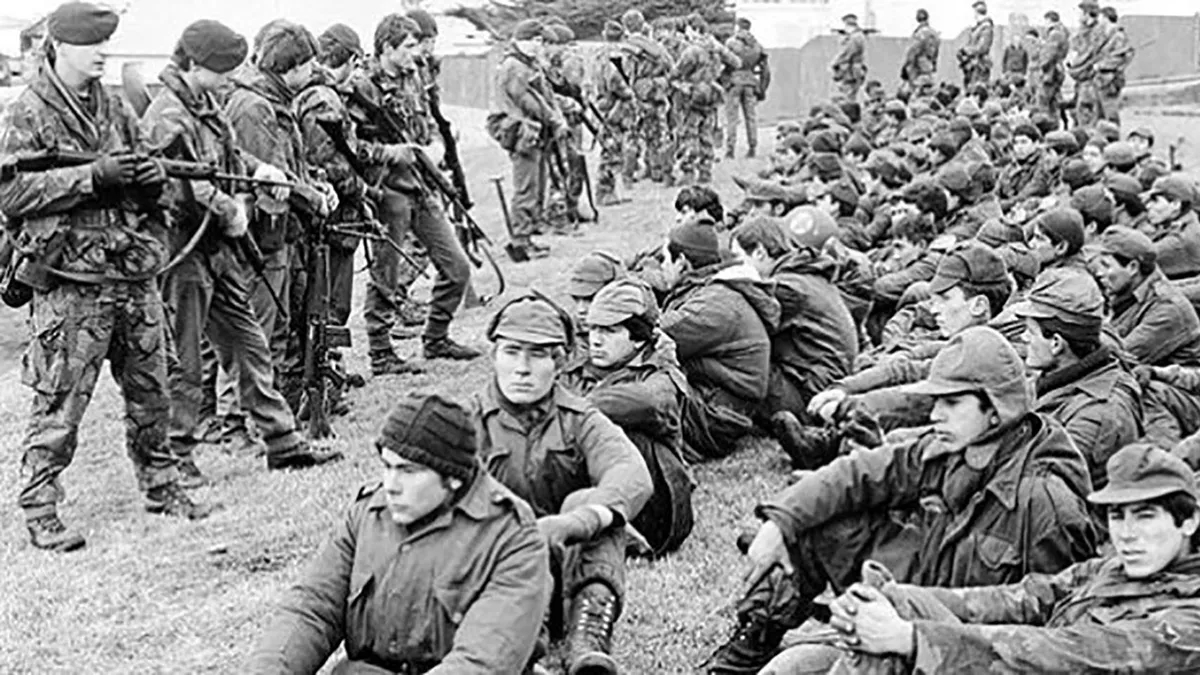
On April 2 1982, the regime launched Operation Rosario, sending 10,000 troops to Las Malvinas and overwhelming the small British garrison at Port Stanley. For Prime Minister Margaret Thatcher, who was facing extreme unpopularity at home, a war was also a convenient distraction. She swiftly sent the British Task Force to prevent Argentina from fully fortifying the islands. The sinking of the Argentine cruiser ARA General Belgrano, and destruction of 23 Argentine aircrafts without losing a single Harrier in combat meant the surrender of Argentine forces on June 14. The defeat accelerated the fall of Argentina's military regime, enabling a return to democracy in 1983.
The Malvinas War soon became a symbol of memory, sovereignty and critical reflection on Argentina’s recent traumatic past, forming part of a broader collective memory tied to national identity. It was the first and only modern international armed conflict that Argentina had been, and while its motives were sinister and result a disaster, territorial claim continues to be state policy. While many visitors to Argentina are bemused by the amount of murals, signs on public transportation, street names, monuments referring to Las Malvinas, these songs tell the story of Argentina's trauma, sadness, anger and longing in different ways.
“Solo Le Pido A Dios” - Leon Gieco (1978)
Although it was written before the war, the song gained a different meaning in 1982 during the conflict. At its core, it’s a call not to look away from pain, injustice, or war, and a simple desire for peace beyond any flag. This is Argentina’s most emblematic pacifist song.
“No Bombardeen Buenos Aires” - Charly Garcia (1982)
Released in the midst of Argentina’s last military dictatorship, and in the same year the war began, Charly García captures the fear and tension in the city of Buenos Aires, at a time marked by a strange, uneasy atmosphere, not only because of the war, but also due to the military tyranny. Through his iconic irony and powerful lyrics, he shows how the city lived in fear of a possible air raid, while also worrying about the young soldiers dying in the south.
“Milonga Del Muerto” - Sandra Mihanovich (1983)
Based on a poem of Jorge Luis Borges, this milonga carries a stark, almost devastating austerity. This version of Sandra Mihanovich brings deep sensibility and a crystalline voice to this wonderful poem, giving voice to a soldier (without specifying which side he is on) who will never come back.
“Reina Madre” - Raul Porchetto (1983)
In this song, Raul Porchetto takes place as a British soldier writing to his mother, telling her he must go to war and questioning why he is being sent to fight in a conflict he does not understand. It was also one of the bravest songs written at that time working as a powerful bridge of empathy: it humanizes the ‘enemy’ and questions the decisions of the military leadership on both sides.
“2 de Abril” - Ataque 77 (1995)
From sadness to anger...released in 1995, this song is a direct criticism of the state and social neglect faced by the veterans upon returning from the islands. With an energetic, confrontational rhythm, it calls for an active remembrance so that the names of the fallen are not erased with time.
“El Visitante” - Almafuerte (1999)
Ricardo Iorio, the most prominent figure of heavy metal in Argentina, wrote this song for the 1999 film 'El Visitante' (The Visitor), a haunting drama that explores the post-traumatic stress of a Malvinas veteran. Raw and powerful, it gives voice to the ‘invisibles’, those who returned from the war but were never able to fully leave it behind.
“Otoño Del 82” - Airbag (2011)
Las Guerras perdidas son los que se llevan guardadas ("the lost wars are the ones that stay with you." This song represents the views of the new generations. Airbag, a modern band of young men who didn’t experience the war, captures the melancholy of that long and cold autumn of 82’. It shows that the issue of the Malvinas still resonates with younger generations, and that the legacy of memory is passed down from parents to children.
“Héroes De Malvinas” - Ciro y los Persas (2012)
It stands as one of the most important modern tributes in Argentine rock. With respect and solemnity, Andres Ciro Martinez pays homage to both the survivors and those who forever remained on the island. This song is now sung in schools and at official ceremonies, helping bridge the generational gap in the remembrance of the conflict.
“La Canción del Soldado y Rosita Pazos” - Fito Páez (2013)
Fito Páez brings us an almost cinematic story about a soldier who left his family, friends and life behind to go to the war in Malvinas, ill-prepared and ill-equipped by the state. It is an narrative that gives the tragedy a name and a face, reminding us that behind every fallen veteran there was a story of common bravery, a life that had to be put aside.