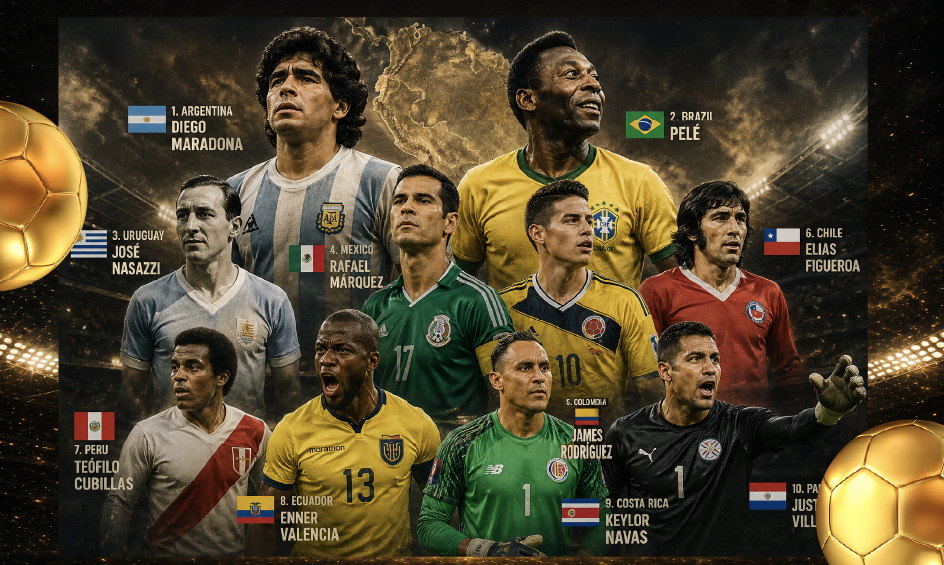
1. Argentina: Diego Maradona
Forget the statistics; this was a religious experience. In 1986, Maradona operated on a plane of existence that shouldn’t have been legally possible. Between the "Hand of God" and the "Goal of the Century," he turned the pitch into his own personal theater of the sublime and the scandalous. He didn't just lead Argentina to a title; he dragged an entire nation to the summit of the world through sheer, defiant will. Messi has the trophy and the longevity, but Diego had the soul.
2. Brazil: Pelé
Three trophies. That is the beginning and the end of the argument. Pelé didn't just play football; he invented the way the world views the beautiful game. From the 17 year old crying on Gilmar’s shoulder in ’58 to the king being carried aloft in the Azteca in ’70, he was the heartbeat of the most dominant era in sports history. He turned the yellow jersey into a global brand and the World Cup into his personal kingdom.
3. Uruguay: José Nasazzi
Before Suárez’s teeth and Forlán’s curls, there was "The Marshal." Nasazzi was the captain of the 1930 squad that won the first ever World Cup, but his legend goes deeper. He was the architect of the "Garra Charrúa," that uniquely Uruguayan blend of grit, spite, and technical brilliance. He led them to two Olympic golds and a World Cup, establishing the tiny nation as a global superpower that refused to be intimidated by anyone.
4. Mexico: Rafael Márquez
They call him "El Káiser" for a reason. Márquez is the only player in history to captain his country in five different World Cups. He was the personification of elegance under pressure, a defender who read the game three moves ahead of everyone else. Whether he was neutralizing world class strikers or launching 60 yard cross field bullets, Márquez was the spine of El Tri for two decades. He brought a European tactical discipline to the Mexican passion.
5. Colombia: James Rodríguez
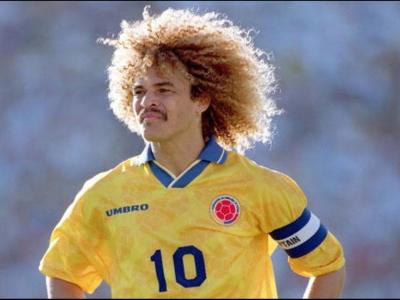
While Carlos Valderrama had the hair and the swagger, James had the devastating impact. His 2014 campaign wasn't just a good run; it was an assault on the senses. Winning the Golden Boot on a team that didn't even reach the semi finals is unheard of. That chest and volley against Uruguay remains the most aesthetic goal in the history of the modern tournament. For one month in Brazil, James wasn't just Colombia’s best player; he was the best player on Earth.
6. Chile: Elias Figueroa
"I am the South Pacific, and Figueroa is the rock." That’s how Pelé described the man many consider the greatest defender in Latino history. Figueroa played in three World Cups, and in 1974, he was so dominant he was named the best defender of the tournament despite Chile being eliminated in the group stage. He played with a suit and tie elegance, never needing to slide because he was always already where the ball was going to be.
7. Peru: Teófilo Cubillas
"El Nene" is the reason Peru is a respected name in World Cup history. A midfielder with the scoring rate of a predatory striker, Cubillas scored five goals in two different World Cups (1970 and 1978). His free kick against Scotland, shot with the outside of the foot, remains a masterclass in physics. He was the creative engine of a Peruvian side that played some of the most flowing, attractive football the 70s ever saw.
8. Ecuador: Enner Valencia
He doesn't just score goals; he carries the hopes of 18 million people on his back. Valencia has scored six consecutive World Cup goals for Ecuador across the 2014 and 2022 tournaments. That isn't just luck; it’s a refusal to fail. In Qatar, he played through pain that would have sidelined most men, proving that he is the ultimate big game hunter. He is the standard by which all future Ecuadorian strikers will be judged.
9. Costa Rica: Keylor Navas
In 2014, "Los Ticos" were placed in the "Group of Death" with three former world champions (Italy, England, Uruguay). They finished top. The reason? A man between the sticks who seemed to have more than two arms. Keylor Navas’ performance in Brazil was legendary, culminating in a heroic stand against Greece and the Netherlands. He turned the penalty box into a fortress, proving that a world class goalkeeper is the ultimate equalizer for a small nation.
10. Paraguay: Justo Villar
Paraguay has always been built on a foundation of granite, and Villar was the mortar holding it together. During the 2010 World Cup, he captained the side to their first ever quarter final, conceding only two goals in five matches. His penalty save against Spain’s Xabi Alonso is etched into Paraguayan folklore. He represented the stoic, unbreakable defensive spirit that has made Paraguay a nightmare for the world’s elite for generations.
Watch all the Latin American World Cup matches with other Latinos and the best atmosphere in London at our World Cup Fiesta