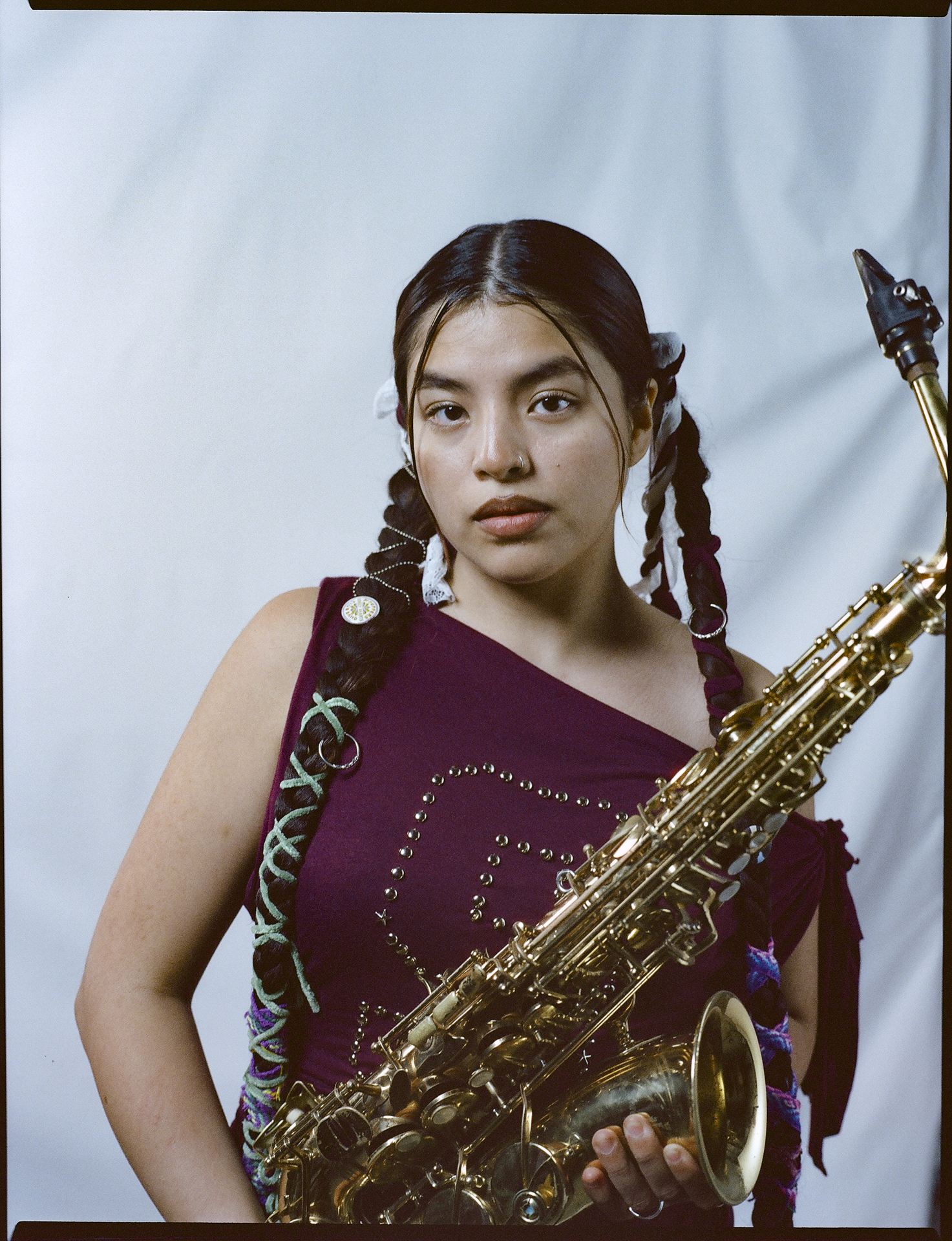
When she was fourteen years old, one day after-school, Allexa Nava's teacher laid out all the instruments the school had available. The idea was that each student would get to try a variety, and whatever instrument the student could get to make a noise, was theirs for the rest of the semester. Of all the instruments, the saxophone was the only one Allexa could get to produce a noise. From then on, she played saxophone three times a week after school.
What started as coincidence became a lifelong passion - Allexa went on to play for the Junior National Conservatoire in Peru and trained as a classical saxophonist before she discovered her passion for jazz music.
“I grew up listening to The Beatles. My mom is such a huge fan of Paul McCartney, he’s her icon to this day. So that’s basically what I was listening to, when we were living there. I think it was like, probably when I was 15 that I went in to jazz. And it was because of YouTube– sometimes you would just log into YouTube and get recommendations. And that’s how I started listening to jazz.”
Calling me from her apartment after a long practice session, Allexa’s face lights up when she talks about jazz.
It was was the KEXP sessions ( the live musical performances produced by the Seattle-based nonprofit radio station KEXP-FM) that she found online that got her going: "I was like ‘Oh my God!’ Like I didn’t know that an instrument, especially my instrument, could do something like that. I don’t know - for some reason I had no knowledge before of all those different musical genres. So it was that video that was like ‘Wow, do you know that someone could express that much through their instrument?’ And then I slowly I went into classic Chet Baker, and Charlie Parker. But it was very mild. And then I heard Chet Baker, My Funny Valentine. I was like, oh, this is beautiful. This is pretty. And I had a teacher at the time, and I would go to him after to ask him to tell me more about him. “
It was during her last year in the Conservatoire when she decided that jazz was the route forward.
“I think it came to a point where I was like, I want to express more outside of the chart I have in front of me. It was 2017, that I started to go to lessons with my teacher and say, well I would love to do more. But in my Conservatoire, there was no training or class in Jazz. We would talk about it but could never explore it. And that’s when I realised that I would love to do something different.”
Allexa’s mom received a serendipitous offer to come to the UK for work, and she realised that if she went with her, that a door tostudying jazz was open. “I was like, maybe I can go to university, and I can actually pursue jazz.”
Studying music at the Trinity Laban Conservatoire in South East London was wildly different to the junior National Conservatoire she attended in Peru. “I didn’t know the terms in English of music stuff. I remember I went into my first lesson, which was musicianship, and I was completely lost. I couldn’t understand anything they were talking about. Like, of course I could hear. But when the teacher was explaining things, I was completely lost. And I remember after my first lesson, I sent him an email saying, I am so sorry, but I can’t understand anything at all.“
Gradually diminishing the language barrier by studying, Allexa worked hard: “I started reading books about music in English, because in school I was learning English, but it’s a different type of vocabulary. Like I didn’t know what a minim was, or a crochet. It took me a while, and to be honest with you, if I have to explain something music-related in English, like the time of the notes and stuff like that, I’m not able to till this day. But I can go to whatever rehearsal, and read the music in front of me, that’s the beauty of music, its its own language.”
Allexa did not just limit her learning to the classroom. Whilst an incredible saxophonist, producer, composer, she also plays the flute and clarinet, instruments she taught herself on YouTube.
“I never got a proper lesson, but the fingering is quite similar, except for some things here and there. And in terms of production, I learned how to use logic by myself as well. It’s kind of a DIY situation when it comes to my music. Now I can call myself a producer, but back in the day I was always like ‘Oh no am I doing the right thing?’”
She credits Colectiva, the Afro-Latina group that she also performs in, for helping her grow her confidence and launch her solo career.
“Being part of Colectiva was life-changing because I always had been a side person, like playing for singers, playing for different bands. I would come to work, play, and then leave. But I think generally being in Colectiva made me have female friends, really close female friends, and there was so much understanding, and interplay between us. It made me come out of my shell as a musician, because I was in front with the other horn players, and I had to play and interact with the music. “
This all-female first band experience couldn’t have been a better introduction into the extremely male-dominated Jazz environment. “It made me comfortable. Being a female musician, in the Jazz environment sometimes you don’t see that much representation.
Now, I feel connected, I feel comfortable, and I feel confident as well,” she says. “If I hadn’t been part of Colectiva, I would never have pursued a solo thing or my own music, because I would still be in my shell.”
Then came Allexa’ solo EP debut, No language, which had two meanings: one, having ‘no language’ after arriving in the UK, and finding refuge in universal language of music, and secondly “because I didn’t have much jazz language due to my classical training,” she says, extrapolating with a smile: “My teachers would tell me, okay, you need to practice this, you need to practice that, because you don't have enough language.”
Two compositions in the EP are from Allexa’s first year of university. “In a way, like I know that, like my some of the melodies are a bit. They have so many jumps here and there sometimes, and they're not quite easy to the ear or even, to play sometimes. And I do think that is because I didn't have much influence in the jazz language before. Now I'm a different person, but this was me at some point.”
The EP was hugely influenced by artistic inspirations like American jazz saxophonist Chris Potter, pianist and composer Brad Meldau and dummer Mark Giuliana, but also by her friends and her culture. “There’a track called the Prophet Is a Fool by Brad Meldau from his album Finding Gabriel. It influenced me in terms of the production style. In my writing, with me doing everything on my laptop, I kind of needed to have an influence as well in terms of production and how you build a song as well.”
“Like the photo of the EP, I remember that I talked to my friends, Sophia Pool, Beatrice Bocconi and Chris Baconi, they helped me with the image. I wanted to mix two things - yeah, I'm a jazz musician, I’m a saxophone player, but I also want to show that I'm from Peru as well, because I think that's really important too.”
How do you feel about being a Latina in the jazz world? Does it give you a different perspective? I ask.
“I know that in a way, you know, I’m not making Peruvian music or heavily influenced by Peruvian music, but I am happy to say I’m Peruvian and I’m doing this. I am happy, just in a way to be representing my country but I don’t feel there’s a pressure doing that.
"The EP titles blends Spanish and English, with tracks like ‘Recortes’ and ‘In the Final’ which, she says smiling, “was meant to be in the final”, slipping into Spanish on the final word. “But everyone calls it in the final.”
In addition to showcasing her EP on the 2nd May, Allexa will perform some of her new music.
“After three years of performing in Afro-Latin and Cuban bands, I’m really excited about incorporating these influences into my Jazz playing. With Afro-Peruvian, of course I’m from Peru, and I want to lean more into that. But I also love flamenco, and I’ve been listening to a lot of that and I love percussion as well, so I’d love to implement that too.”
You can find Allexa’s EP ‘No language’ out on all streaming platforms now https://allexanava.bandcamp.com/album/no-language
See her live at La Linea music festival. https://comono.co.uk/artists/latinas-of-london/