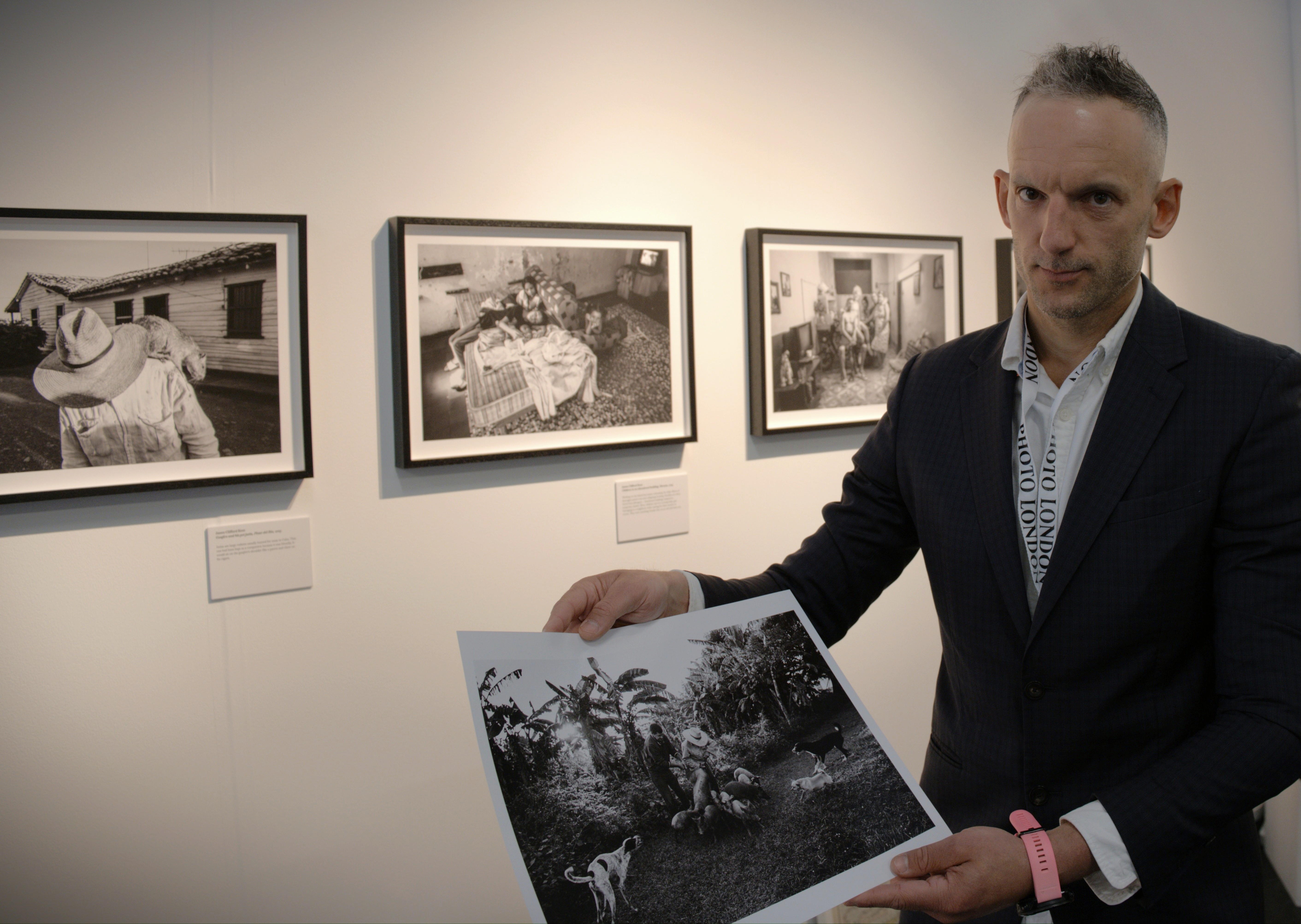
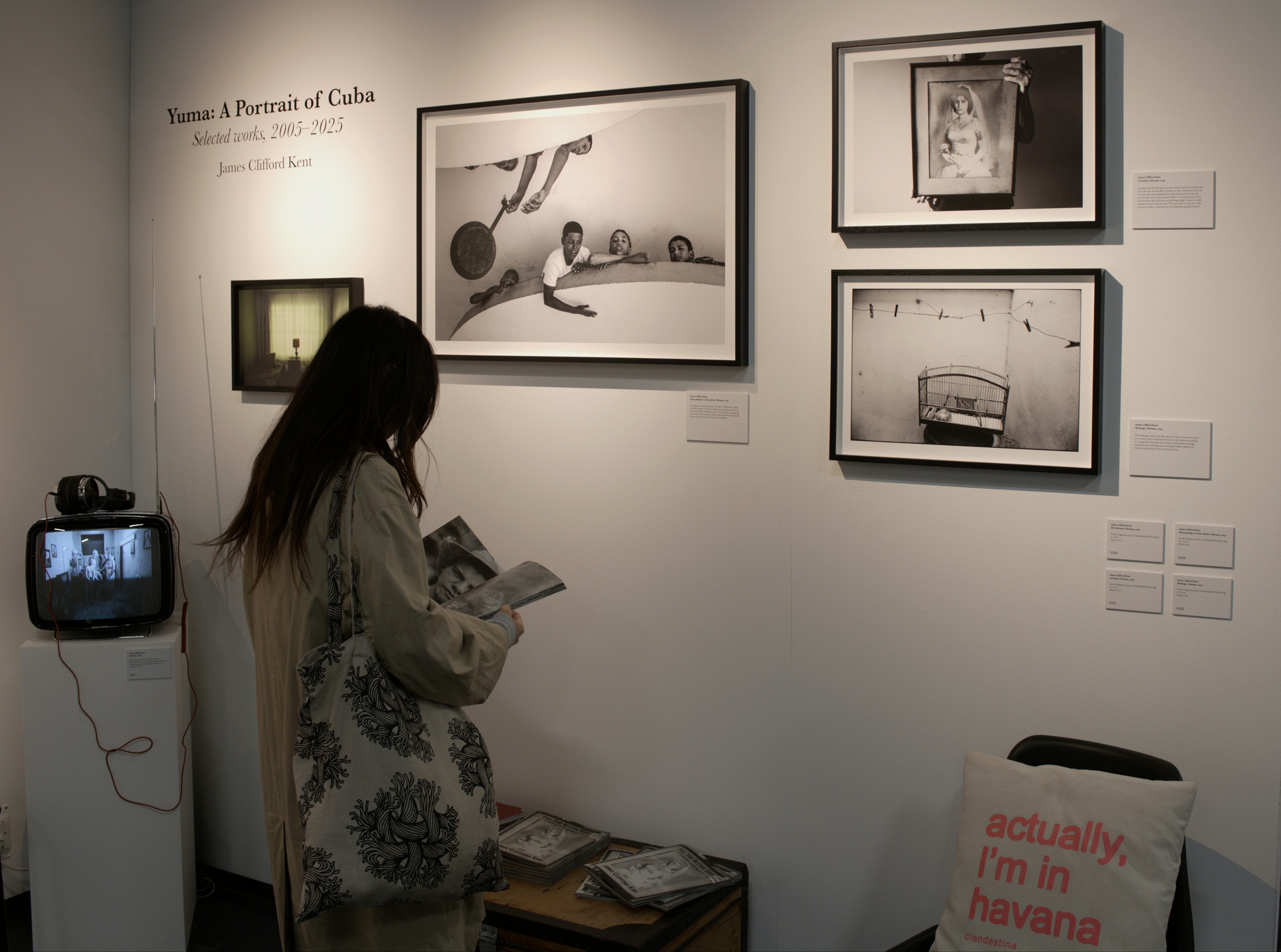
You are here at Photo London with images from your Cuban photo project Yuma covering 25 years, from 2005 to 2025. How did this connection with Cuba begin?
It’s funny really. The simple things that can start a lifelong love affair. I had seen a Rage Against the Machine CD that had the famous Korda image of Che Guevara on the cover, and I had seen the Wim Wenders documentary about the Buena Vista Social Club, which showed this incredible country and people, and I was curious to find out more. I just had to go, and I went. These images are some of the photographs I have taken over the last 25 years.
Was the plan from the beginning to document your journey and create a series about daily life in Cuba?
No. Not at all. When I first went to Cuba I wasn’t working as a photographer. I was self-taught and I had been given a camera and I wanted to take pictures but I didn’t have a job. I was living with a Cuban family, who sort of adopted me, and pretty much on my second day in Havana I got a job at the university as an English teacher. I think the dean of the university took pity on me.
So you got an instant immersion in Cuban culture.
Yes. The dean marched me straight into this room to meet some students, who ended up being my students for the whole year. One day there was a blackout and the students were dancing salsa. No music, they were making their own music, and singing and dancing and it was just so special. Growing up in London I had never experienced that before, the energy, the resilience in the face of adverse circumstances, the joyous spirit. That was like the moment I fell in love with Cuba.
When did your journey as a photographer begin?
I didn’t really have a plan at first, I was just making sense of this new world by taking photographs of everything, the food, all these dishes that I had never eaten before, and the city, and trips to tropical Caribbean beaches, and meeting all these cool characters. And I would send the photos back to family and friends who were worried about me being so far from home just to say I’m fine, it’s all good.
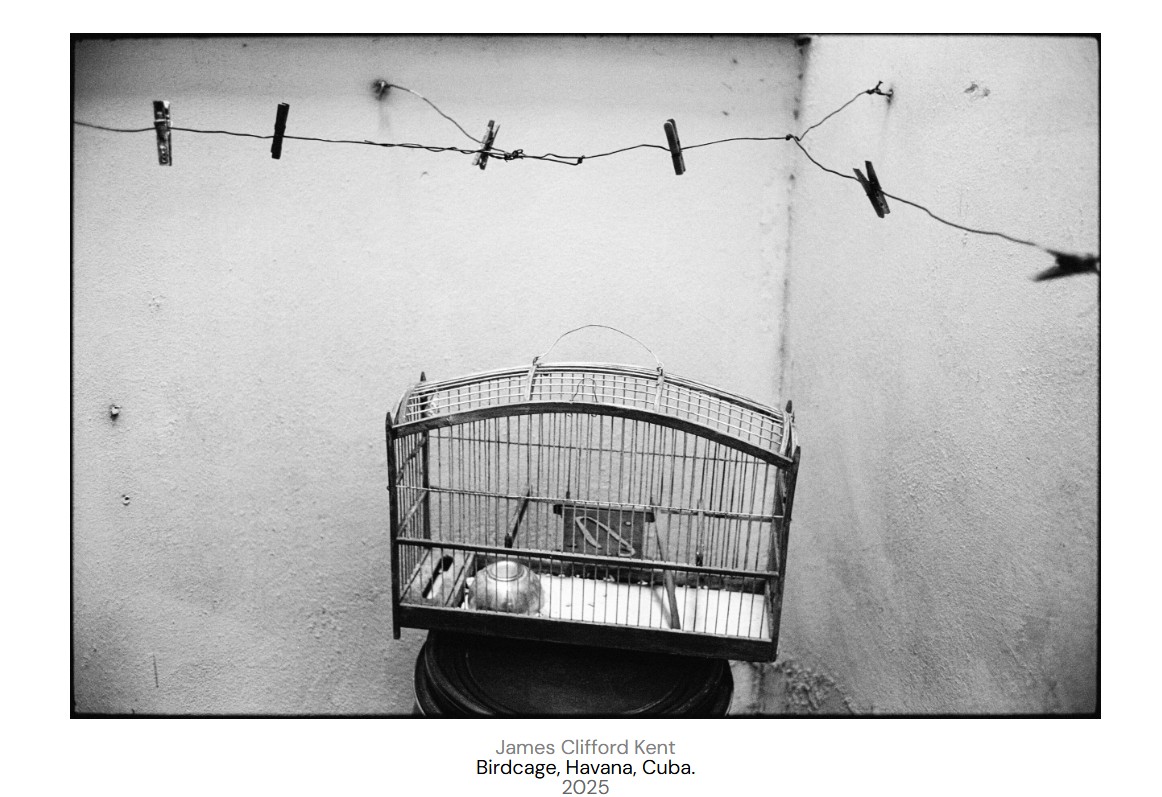
The empty birdcage is a striking image. Is it symbolic of the extreme difficulties Cubans are facing nowadays?
The photograph of the birdcage is from 2025. It was on the balcony in Havana where I was living in 2005 and back then I would listen to this canary sing and soak up the sounds of the street, the people shouting out greetings and laughing, the newspaper sellers, and the music from the vintage cars known as almendrones, passing by. In 2025, I took the photograph of the empty birdcage and it felt like a symbolic image of the island, where the people are trapped by hardship, but also emptying out, because of the mass exodus of people trying to get to the USA or anywhere else they can.
Your photo project is called Yuma, which is Cuban slang for the USA, and also for anyone foreign. Is that because you are the yuma taking the pictures?
I met a taxi driver called Carlos Marcel, and we became best mates. Taxi drivers in Havana are like fixers, they know where to get things, and he showed me places foreigners don’t go. Travelling around with Carlos I started picking up the local lingo and, yes, yuma is like gringo. It can be used in a derogatory way but also affectionately. I embraced it in a Tony Montana kind of way, I would say I was THE yuma,
And the project developed from there, as you started to explore beyond Havana?
My adopted family in Havana, took me under their wing and they had family members that they would visit in a remote part of the island where they were living without running water, without electricity, without a fridge, things I had never experienced before. It was there in the countryside that I made a deep connection with Cuba and started to make close emotional connections with the people whose lives I wanted to document. The photos in books I saw back then of Cuba were either black and white photos of the revolution or glamourized colour shots of the vintage cars and fading facades along the Malecón, the seafront in Old Havana. I wanted to capture the lives of the people I met.
Were you influenced at all by Cuban photographers. The epic chroniclers of the revolution? Is that why you chose to work in black and white?
Yes. Of course. The black and white photos of Che Guevara by Korda and Raúl Corrales are iconic, as are the photographs of Fidel Castro by Roberto Salas. They were the photos you saw everywhere, a deeply ingrained Cuban aesthetic, so I thought that’s how I should photograph Cuba, in black and white. I had also grown up with the Face magazine, so Mario Testino and David Bailey were my references. It felt natural to me to be taking the photos in black and white.
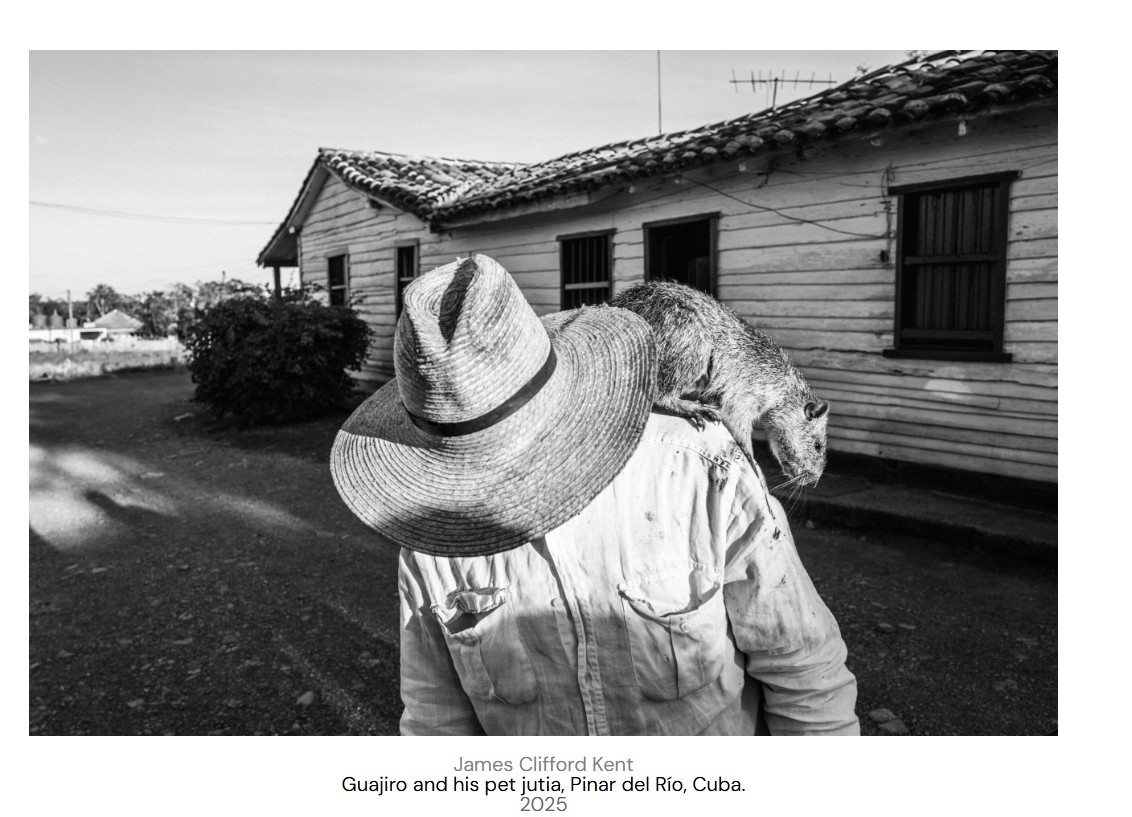
I am a huge fan of the Cuban photographer Raúl Cañibano. The juxtapositions and odd angles in his black and white photographs are surreal and unique. Was he an inspiration?
Cañibano has definitely been a big influence on me. On a personal level he’s been like a godfather to me, a mentor. He was standing next to me when I took the photograph of the Guajiro and his pet jutia (a large species of rodent) in the tobacco growing region in Pinar del Rio. People eat jutia in Cuba and it’s an important source of protein and considered a delicacy. So despite the widespread shortages, which are worse than ever now, and meat being so sought after, this Guajiro had kept the jutia as a pet because it was so friendly. It would sit on his shoulder like a parrot and chew on cigars. The image speaks to me of the Cubanidad, the compassion of the people. I think the the tenderness of this Guajiro, whose life is so tough toiling in the harsh tropical sun, is tied to the choteo (irreverent humour) that helps the Cuban people get by in times of adversity.
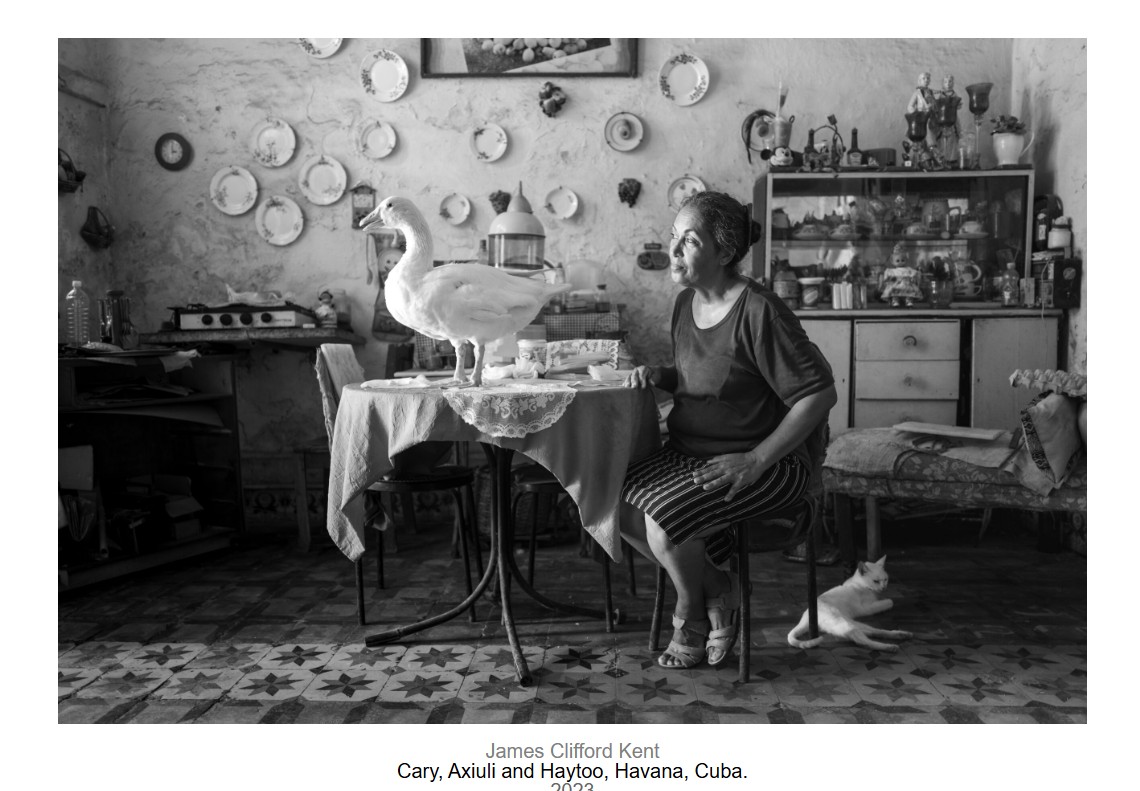
What is the story of the lady who has the goose on the table and the kitten on the floor?
Cary lived by the bustling San Rafael market in central Havana. She welcomed me in to her home and it was like something from a Hans Christian Anderson fairy tale. Her apartment is in this huge building that used to be a Chinese laundry. Her ancestors were Chinese Cubans and her uncle had come from Guangdong in Guangzhou Province. She looked after dogs and cats, and would always be carrying around this white goose like some Old Mother Hubbard. She was very proud of being photographed and she would do her hair and makeup when I photographed her. It was only after I looked at the finished photo that I saw the situation in Cuba reflected in in that empty egg carton behind her and the empty bottle of oil on the table, and what it says about the daily reality of shortages. This photograph was shown in the National Portrait Gallery and it is very special to me because the other photographs I took of her that day are garbage, but when the cat flicked its tail around the chair leg, everything just clicked, and the photograph works because of that.
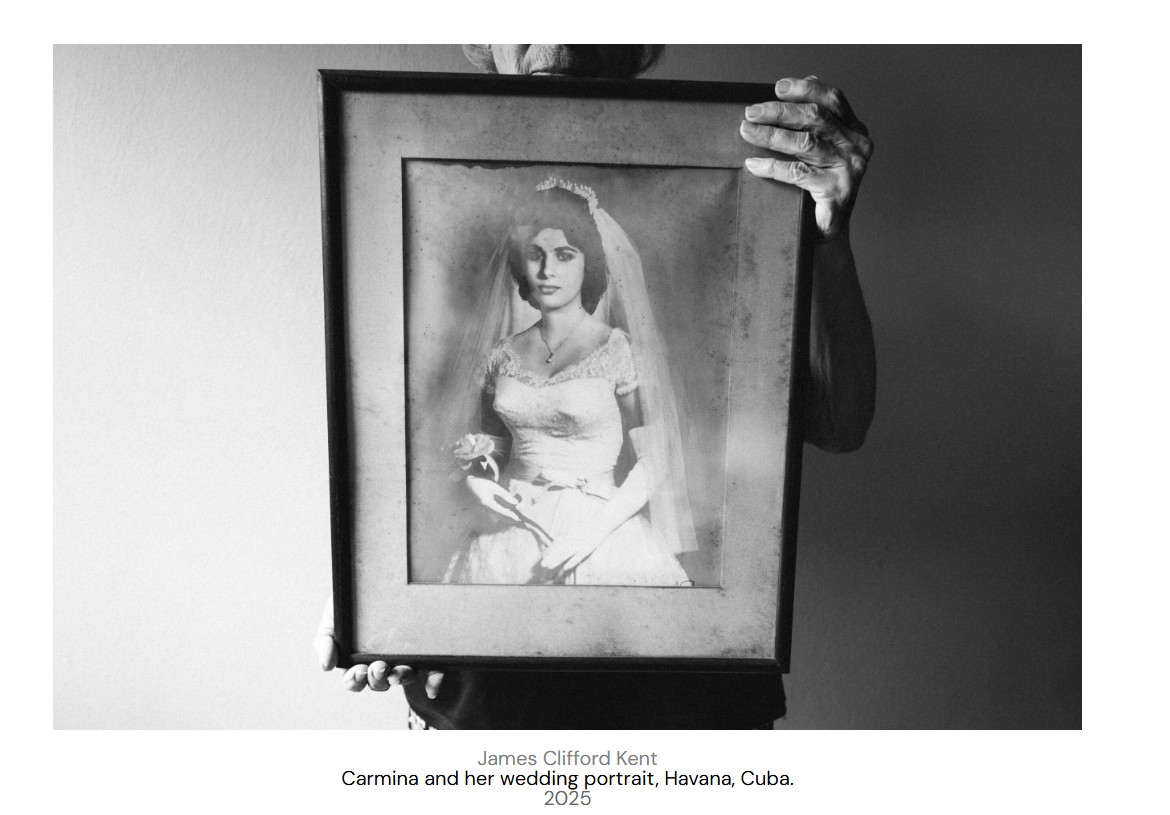
The photo of Carmina, the woman who is holding up a photograph is very intriguing.
Carmina is the first Cuban I met really. I lived with her and her family for the first year and she was like my surrogate grandmother. I was very green, and didn’t speak much Spanish, and Carmina and her family taught me a lot about life in Havana and how it works. They would wait up for me if I was out for a night like grandparents, and we would watch Brazilian telenovelas together in the evening. When I went back to Cuba I would always take a portrait picture of Carmina but last year her husband Jose Luis, who was like a grandfather to me, died and she was still grieving deeply. She said she was too old for a photograph but then picked up a photo of her in her bridal dress on her wedding day and I took this picture.
When did you start to publish your photographs? When was the shift from chronicling Cuba for yourself to these series you do of Cuban stories?
For me, the shift from simply taking photographs of Cuba to taking on a responsibility to tell these stories - something I had to do - came in 2016 when I got a text to say that Fidel Castro had died. I knew I had to be there for such a historic moment for the island so I jumped on a plane and every photographer from everywhere was there. But I knew I had to document what I saw, because I had this long connection with people and I knew I could tell their stories. I had never had any photos published before but the ones I took on that trip were published in the Independent and that was the shift that changed everything for me. That started my professional career.
What has changed in Cuba over the 25 years you have been photographing it?
The death of Fidel was obviously a major event but the pandemic was even more traumatic. Since then the country has been on its knees. It is a country on the brink. Not a single member of the family I had lived with apart from Carmina, is living in Cuba now. The younger working age generation have left in droves, first by plane to Nicaragua and then by road up through Central America and Mexico, paying coyotes (people smugglers) to get to the US. Check the statistics, but they say in Cuba that roughly two million people have left since the pandemic. It is the largest exodus in the island’s history. Havana has become a waiting room for people from all over the island who are desperate to leave. When Trump happened it was another huge blow. People are in between a rock and a hard place. In Cuba life has never been tougher for Cubans, and in the USA with Trump and ICE targeting migrants things are tough too.
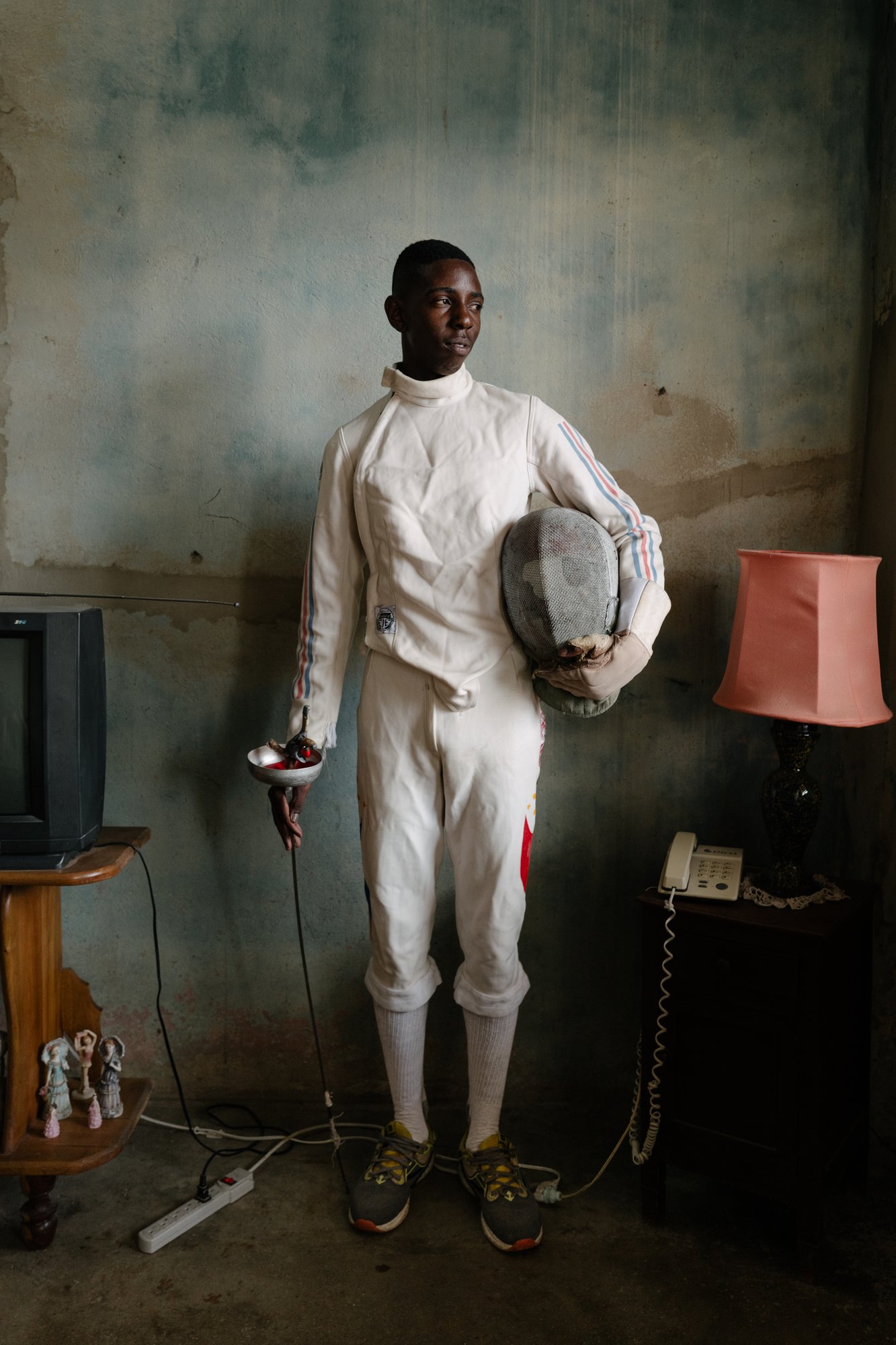
You also have a fabulous photograph of a young Cuban fencer in colour that the David Hill Gallery is exhibiting.
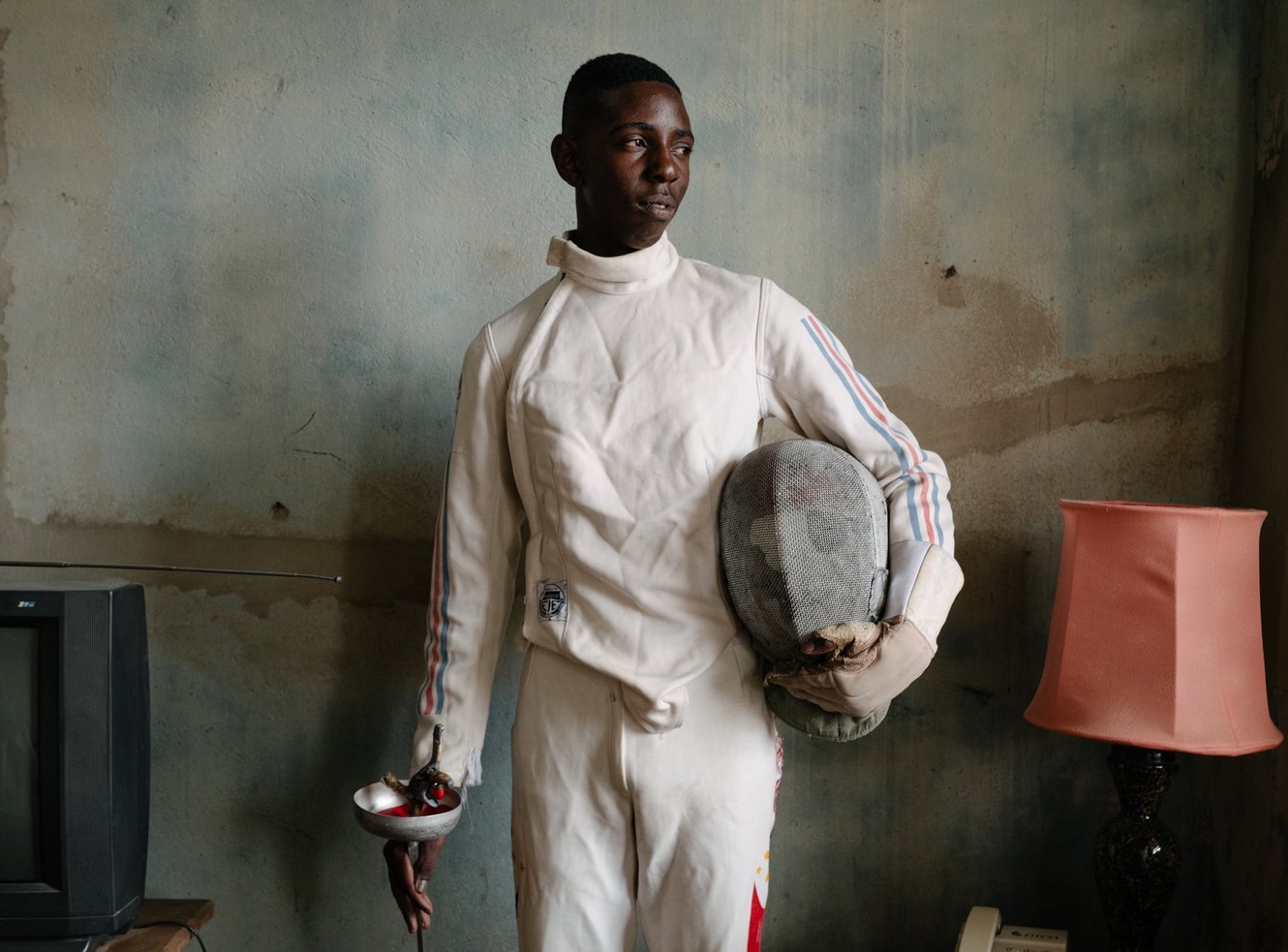
You are only as good as your last picture and this is my last photograph from Cuba. I was in Pinar del Rio working on a documentary and by chance I met this young fencer. Neisser is a fencer and he wants to be a pentathlete but the documentary guys were in a hurry to move and I was like please give me five minutes. So Neisser disappeared and came back with his epee repaired with bits of string - Cuban style - and his fencing mask and I was just able to take the picture using the natural light. Despite the rush it was like a mic drop moment for me. Being a photographer is about listening compassionately to people’s stories, being open and empathetic not just snapping off images in a voyeuristic way but getting to know people, engaging with them, going back to see them, and building a relationship over time. On an island that is suffering daily hardships, the boy with his epee and his dreams of being an athlete is a story of hope and epitomizes that special Cuban spirit.
So what have you learnt from your experiences in Cuba?
I owe everything to Cuba. I just did a series of photographs for the BBC about NHS midwives working on the maternity ward at West Middlesex University Hospital where my daughter was born in 2020. I did a 24-hour shift to get to that place of respect and understanding where I could capture images that do justice to the people whose work I was documenting. It was Cuba that taught me how to listen like that. My way of giving back is taking that spirit with me and channelling it into all the projects that I do, whether it is social documentary or fashion or music.
Do you plan to continue with the Yuma project in Cuba?
I’ve just made a Zine featuring images from the Yuma series and I want to use that as catalyst for a book that brings together all the stories. There is this horrible cliché, a reductive and anachronistic stereotype, that Cuba is an island trapped in time, with the vintage cars and crumbling buildings. Of course it is not trapped in time, Cuba and Cubans are constantly having to adapt and change like everywhere in the world and I hope my photographs take people beyond the cliche. Now I have twenty years of Cuban stories to tell and a curator, Malak Kabbani from David Bailey’s studio, who has a great eye and has been helping to curate the work. So now is time to publish a book, maybe a film as well. This is a very exciting time for me and my pictures of Cuba.
Photo London is open to visitors at Olympia, Kensington through Sunday, 17 May. For more of James Clifford Kent’s Yuma series, check out his website yumastudios.com or Instagram @jamescliffordkent
Russell Maddicks is a travel writer, author and co-author of guidebooks covering the Balearic Islands, Colombia, Cuba, Ecuador, Guatemala, Mexico, Nicaragua and Venezuela. His latest book Culture Smart! Costa Rica was published in January. Follow him on X and Instagram @LatAmTravelist.