

Our call opens like a small window into his life. Through it I can see Ed Maverick’s studio in Delicias, a small city in the northern Mexican state of Chihuahua. Wood-panelled walls, a leather armchair, keyboards stacked against each other, a microphone waiting its turn and a red velvet curtain that could have come straight out of a David Lynch film. Eduardo Hernández Saucedo lights a cigarette, takes a sip of coffee and smiles, as if we had met before.
Ed, as he is called, laughs easily and speaks slowly, in the unhurried Spanish of the Mexican north. He started sharing songs online as a teenager, and Fuentes de Ortiz, released when he was 17, has since passed 800 million streams on Spotify and more than 500 million views on YouTube. He signed to Universal at 18, and by 21 he had reached the top five of the Spanish singles chart with Párteme la cara, his appearance on C. Tangana’s El Madrileño, and performed at Coachella.
But nothing happens overnight; since he was 14, Ed was gigging intensively. Whenever someone asks him what kind of music he makes, he says folk, “but really it’s the combination of all the references I listen to, so it’s kind of hard to categorise. At its core, I think it’s singer-songwriter music.” Out of the music of northern Mexico and decades of sounds from around the world, he composes his own universe, one that seems to hold an entire landscape.
That universe began at home. Ed arrived in Delicias as a child from Ciudad Juárez, on the border with El Paso, “a very different context” he clarifies knowingly, still remembering “how fresh the air felt after the harshness of the border.”
His grandmother kept the radio tuned to Romántica 102.1 FM, a station of seventies love songs (Roberto Carlos was never far away), and which Ed still listens to, “it’s all romantic music, all very nicely curated. Every now and then they play something really ugly, maybe one song I don’t like, but almost everything they play is beautiful.”
From his sister, Ed took Nirvana, Pearl Jam and Kiss, from his brother, heavy metal - from Korn to Pantera - and from his father, the old banda music and the corridos of groups like Laberinto. Outside the house, the streets belonged to the brass of the Sinaloan bands: Banda MS, El Recodo, Banda El Limón and La Adictiva.
At that time, the progressive corridos as well as the movimiento alterado, a hard-edged wave of corridos from the 2000s, were at their peak. As he grew older, the sierreño sound arrived, the sparse, guitar-led music from the mountains, carried by voices like Ariel Camacho, Virlán García and Alta Consigna, which seemed to fill every street of his adolescence.
“I loved all of that once I started secondary school,” he tells me. “It doesn’t quite fit the question, but it was really crucial for the music I make today.”
Everything Ed knows about music he taught himself or learned from whoever was willing to show him. His first teacher was Hugo Rivera, a young musician at the church he went to as a boy.
“In a small church it was easier to get close to the musicians. I was still a kid, so I hung around them, but I wasn’t a musician. One day, I asked Hugo to teach me. He said, ‘well, I’ll teach you if you want,’” Ed remembers. “And so on Saturday mornings he’d invite me to play the drums, which was the best way in, easier than understanding chords, harmonies and keys. The drums are more primitive and intuitive, the most accessible thing in every sense.”
Hugo also taught Ed cumbia and, when he started secondary school, he was the only one at school who knew how to play it. “That caught the attention of the main norteño band at school who were becoming popular. They needed a drummer and recruited me.”
During rehearsals his bandmates showed him his first chords on the guitar, and soon he was playing bass too. It was the height of the sierreño wave, country music from the nearby highlands Sinaloa, Sonora, Chihuahua, and Durango.
“Sierreño music became so fashionable that honestly, everyone was learning to play guitar. Those musicians have their own way of understanding music,” Ed explains, as he goes on to describe his first performances with his high school band at Presa Las Vírgenes, a reservoir on the edge of Delicias lined with open-air eateries selling traditional dishes of freshly-caught fish.
“I’d grab the snare, the guys would grab the guitar and the bass, and off we’d go to the dam. Literally table to table, saying ‘whatever you’d like to chip in, whatever you’d like to give us.’ Then at some point we’d say, ‘okay, it’s fifty pesos a song.’ At fourteen, walking away with 500 pesos after an afternoon of playing songs was incredible.”
The gigs soon came flowing in, thanks to essential dates in the Mexican calendar…Day of the Dead, Mother’s Day, Independence Day. In the north, Ed says, if you play well, music is never just a hobby.
“As soon as you start sounding good with your band, it’s easy to get gigs, because everyone is looking for bands for their parties, their weddings, their quinceañeras. We carried serenades to people’s homes and to the graves of their loved ones,” he remembers fondly. “We’d finish at seven in the morning, with four or five thousand pesos, which at the age of 14,15,16, is a lot of money!”
Ed was a quick, streetwise kid. “Even when I was very little I was pretty sharp. My parents had high hopes for me and told me how clever I was, but I still didn’t feel I was made for anything,” Ed says, introspective. That changed with the band. “We had so much fun, singing with the crowd, and on top of that, people paid us for it, so I thought, ‘that’s it, nobody’s moving me from here. This is my thing.’ That’s why I stayed. It was like, ‘wow, I can actually have a job, I’m good for this. I really like how I sound with others.’”
In 2018, at 17, Ed released Mix pa’ llorar en tu cuarto (a 'Mix to Cry to in your Room'), produced with Eidan Velázquez on a small independent label. In Mexico, a mix is the homemade compilation you put together for yourself or for someone else, songs for a heartbreak, songs to cry to, and the album had exactly that feeling, a teenage mix made in a bedroom, sung with the voice and harmonies of norteño. Songs like Acurrucar and Fuentes de Ortiz found their audience on YouTube and social media. The major labels came knocking and the rest is history. Looking back, Ed speaks of that first record with a kind of paradox.
“The mix is the simplest thing in the world,” he says, “but that’s also what makes it more complex, because it isn’t so obvious. They were norteño compositions, but they sounded different, they sounded sadder, they put you in a specific mood.”
Those songs resonated with his audience, because, as it turned out, “that era of sad folk hit all of us.” To realise why his music resonated with so many, however, it took for Ed to listen to another folk singer, who emerged after him: “When I listened to Kevin Kaarl, it was like, ‘ah, okay, this is what people feel when they listen to my music’, and it became obvious.”
To describe that mood, Ed reaches for Beach House, the American dream pop duo known for slow, hazy, enveloping albums. “Even though the sound isn’t very similar, for me it was a lot like listening to Beach House.” What he means is not a sound but an atmosphere. Beach House makes records you don’t so much listen to as inhabit, spaces with their own weather and light, and Ed’s songs do something similar, building a whole universe out of the place they come from.
“Here in Delicias it’s very calm, and reflecting the city through music made a lot of sense to me, even if it sounds obvious,” says Ed. “Delicias shapes how my music is going to sound, together with my own vision.”
Ed’s new album, Sin agua es ruta yerma, began as a series of instrumental sketches, and is the first album he has produced himself. “I didn’t study music production, I’m completely self-taught. For years I’ve been lucky enough to have really patient producers who’ve deciphered what was in my mind,” he says of the whittling down process, from almost 50 pieces of music to 20. “Getting to the place where I’m comfortable to think of something and just do it, without having to ask anyone. It’s been a really beautiful journey, honestly.”
The album is also a product of what he describes as a magical period of psychedelic experimentation which began after the pandemic. “I had a lot of time on my hands and I was able to sit down for entire days listening to thousands of records and just enjoy them,” Ed says, explaining how he re-discovered major artists he’d overlooked. “I began to be more open to artists like the Beatles, who before I’d been more resistant to, because they were so influential and overplayed to the point they’d become a kind of a meme.” That experimentation was “very, very, very inward”, he says, and that introspection shapes one side of the album’s duality, which he calls “fundamental”, while the other turns towards love.
As a producer, everything began for him with Mac DeMarco, Connan Mockasin and Tame Impala, and with “that kind of sound, between lo-fi and hi-fi.” Ed also rediscovered old school Argentine rock, Spinetta, Almendra and Charly García, and Brazilian popular music, especially Arthur Verocai, whom he listened to constantly while making the records, and Erasmo Carlos. When Helado Negro came to Delicias to play with him, he introduced him to Las Grecas, a seventies flamenco duo from Spain, and Ed was hooked.
But it is the old norteño and tejano bands such as Intocable that Ed always comes back to. “For me they have the most beautiful melodies. It gives me that feeling of Bonnie Tyler and all that super passionate eighties music, but norteño.” On Desierto, one of the quietest songs on the album, the production recalls Julee Cruise’s Floating into the Night, written by David Lynch and Angelo Badalamenti, while the melodies lean towards Junior H, one of the leading voices of the new corridos.
All these retro influences, plus an eerie 90s desert feel, a la David Lynch’s Twin Peaks, which Ed is currently obsessed with, are all in the sound of Ed’s new album, which is “very desert-like, at least for me. A kind of cowboy, western, psychedelic thing.” Hence the title, roughly translating as 'Without Water, the Path is Barren: “I wanted that feeling without writing the word desert in the title. Either way, the name is like a notice, a reminder, a warning, you know?”
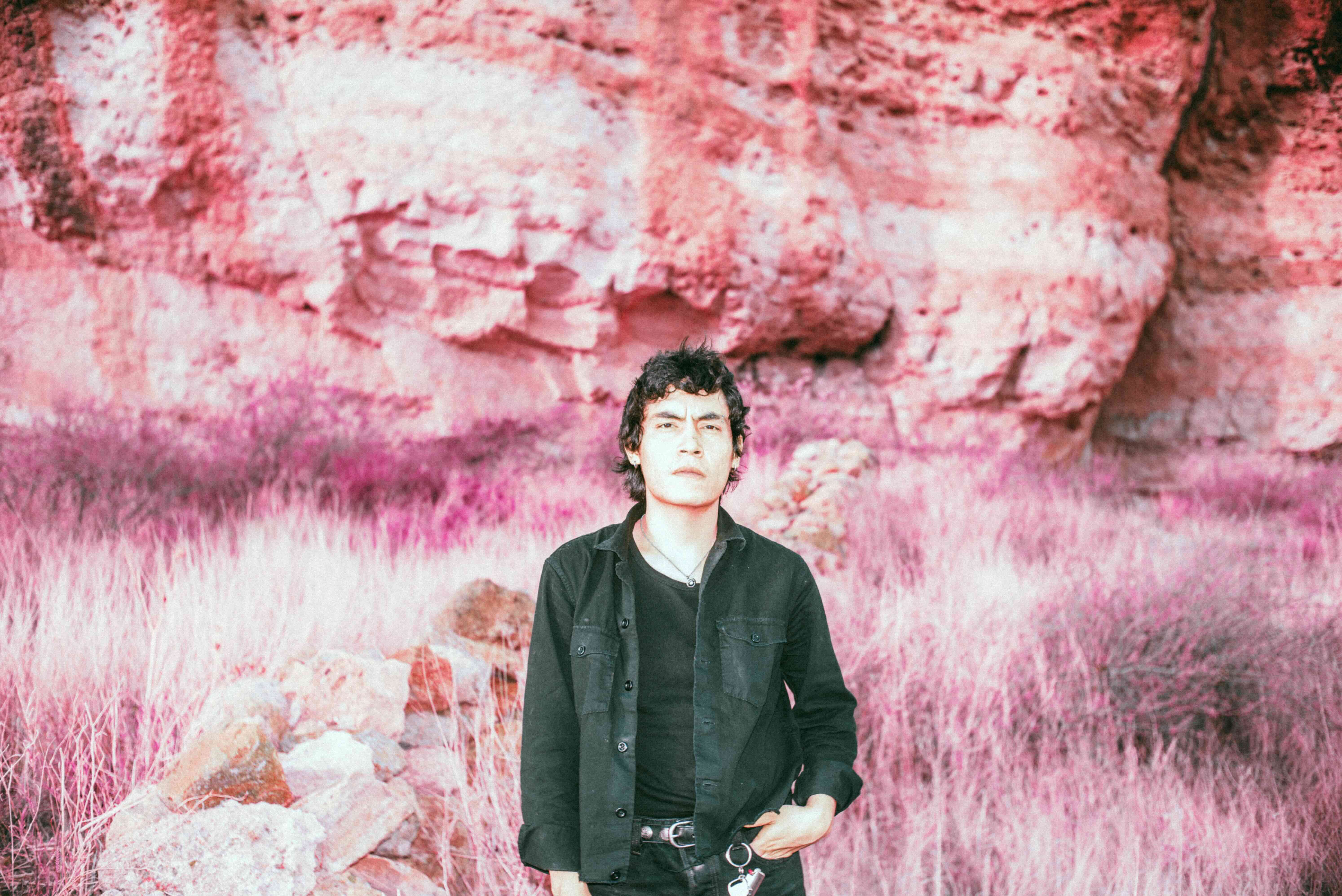
Away from warnings y cosas feas, Ed's life in Delicias follows its own rhythm. “My days start with a visit to my local cafe, literally the best coffee I have ever had,” he says, before returning to his studio where “I am currently working with a young norteño musician from Chihuahua who blends classic ranchera with references like Dyango, flamenco voices and eighties sounds.”
This is the universe I peer into through the small window on my screen. A studio, a cigarette, a cup of coffee, his grandmother’s radio, a church, a school band, family outings by the reservoir, open, dry desert plains stretching toward the horizon, a quinceañera party in Delicias.
The rest is in the songs.