
“Despair possesses a calm all of its own
The nights are longer than the days
The fear was a part of us all!
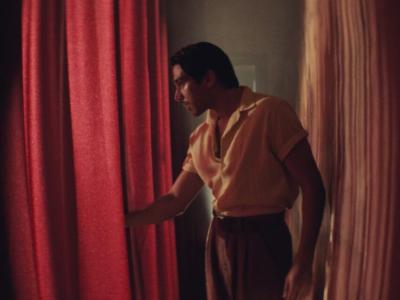
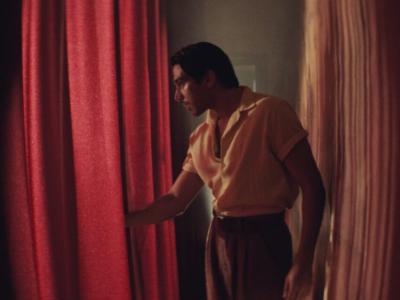
‘Narciso’, was inspired by the short and dramatic life of Bernardo Aranda, as written in the historical novel by Guido Rodríguez Alcalá. It is a film that smoulders with desire and forbidden passions that have to remain in the shadows, due to the oppressive & unrelenting ‘morality’ campaign that floods the country and its airwaves, led by the country’s military dictator Alfredo Stroessner from 1954 to 1989. Gay bars are brutally raided with everyone ill-treated and taken away.
Martinessi’s first debut film was The Heiresses which was very well received, it is also set in Asunción, Paraguay and expresses his deep feelings for the place and its people (https://www.latinolife.co.uk/articles/breaking-mould-paraguay).
Likewise Narciso takes place in Asunción, this time in 1959. Narciso Arévalos (a charismatic Diro Romero) returns from Argentina to work at the radio station with new ideas. He mesmerizes everyone, in particular the Radio Director Lulú Bermúdez, who though married, falls for him. He has less effect on the wife and administration lady of a certain age, who are horrified by his lax attitudes, and the ‘corrupting’ influence of the new music. An enthusiastic rock ’n roll fan, Narciso, with the arrogance of youth, introduces Bill Hayley and the Comets, Buddy Holly, Little Richard and Chuck Berry to a stunned station.
It is a mind- boggling moment for the director (a superb Lulú Manuel Cuenca) who is both fascinated and full of complaints, while the young local audiences that fill the little radio theatre are thrilled to the bone. Narciso’s attitudes and manner both shocks them and overwhelms them with fascination.
Narciso becomes the star of the radio overnight and his groupies crowd into the theatre with screams of delight whenever he appears. He becomes a catalyst for their hopes, as he inspires desire and obsession in both sexes, representing a freedom that none feel they can ever hope to achieve. He represents a sort of mystical creature that manages, unlike them, to rise above all the oppression and shine, both inspiring jealousy and clearly dark strong passions.
An alumnus of the London Film School, Marcelo Martinessi has always preferred to portray his country in his movies. Here he delves into his own personal experiences running a radio station in Paraguay, giving this film a deep authenticity that is very moving. The Art Direction is spot on and the period feel is intense and accurate. Martinessi’s attention to detail with the characters that populate the film are beautifully drawn, no doubt in large part from people in Asunción, whose lives he has long known and understood from his own experience.
Narciso’s huge success at the radio challenges the traditional troupes of folk songs during a period when Luis Alberto Del Paraná was at his height, with his harp and musicians. The troupe has occupied the Saturday evening entertainment slot for some time, with their colourful female singer, Chinita Monitel, the Queen of Paraguayan music singing her version of classics like ‘Galopera.’
However, Chinita also gets drawn into Narciso’s circle and to the horror of many who think she is prostituting herself, but to the delight of the audience, she manages a rock rendition of ‘Lucille’ (Little Richard) with Narciso and his band, that would have done Janis Joplin proud!
The radio broadcasts daily plays and the government find ways to criticize their choices, especially when ‘Dracula’ is on. The characters dress up for their small audiences and the story instils terror in the audience and listeners all over Asunción, for it echoes the repression that they are living under. Who in reality is Dracula now?
The film boasts international stars like Nahuel Pérez Bizcayart who plays Mr Wesson, an engineer who comes to work on the local dam bringing fresh potable water to the city. This gives the film a international outlook on the global stage but sadly, Bizcayart is not really given all that much to do in his cameo role, wasting his very notable talents.
Overall, there is a combination of love mixed with nostalgia, in particular for the people, with the rich variety of interesting characters that seem to be obliged to live in the shadows of a city out of fear of their lives. Very possibly with reason, for the young magnetic Narciso is mysteriously found dead. The airwaves then become clogged with obliging comments: - “The murder of Narciso has exposed a secret society of depraved and perverted men”
The Paraguayan cast includes Margarita Irún and Arturo Fleitas, with support from Natalia Cálcena, Aníbal Ortíz, Belén Vierci, Maca Candia and Mimi Monte. The cinematography by Venezuelan- French director Luis Arteaga fits in with the period, with soft lighting and shadows, with sound work by Miguel Martins and Fernando Henna. The whole ensemble is held together beautifully with the original score by Spanish Goya winner Zeltia Montes.
Nothing much seems to be done to discover who was behind Narciso’s untimely demise, but the mystery remains and the dark forces that caused it hang ominously in the air.
Narciso (2026) screened at the Berlinale Panorama section.
Writer/Director: Marcelo Martinessi/ Book: Narciso by Guido Rodríguez Alcalá / Producers: Sebastian Peña Escobar and Marcelo Martionessi/ DOP: Luis Armando Arteaga / Art Director: Carlo Spatuzza and Barbi Targino / Sound Fernando Henna and Miguel Martins/ Editors: Fernando Epstein and Marcelo Martinessi/ Original score by Zeltia Montes Muñoz,
Cast: -
Radio director: Lulú: Manuel Cuenca / Elvida: Natalia Cálcena/ Roque: Alberto Sánchez Pastor/ Gota: Margarita Irún/ Narciso: Diro Romero/ Mister Wesson: Nahuel Pérez Bizcayart/ Actor of Dráacula: Arturo Fleitas and Maca: Macarena Candia.