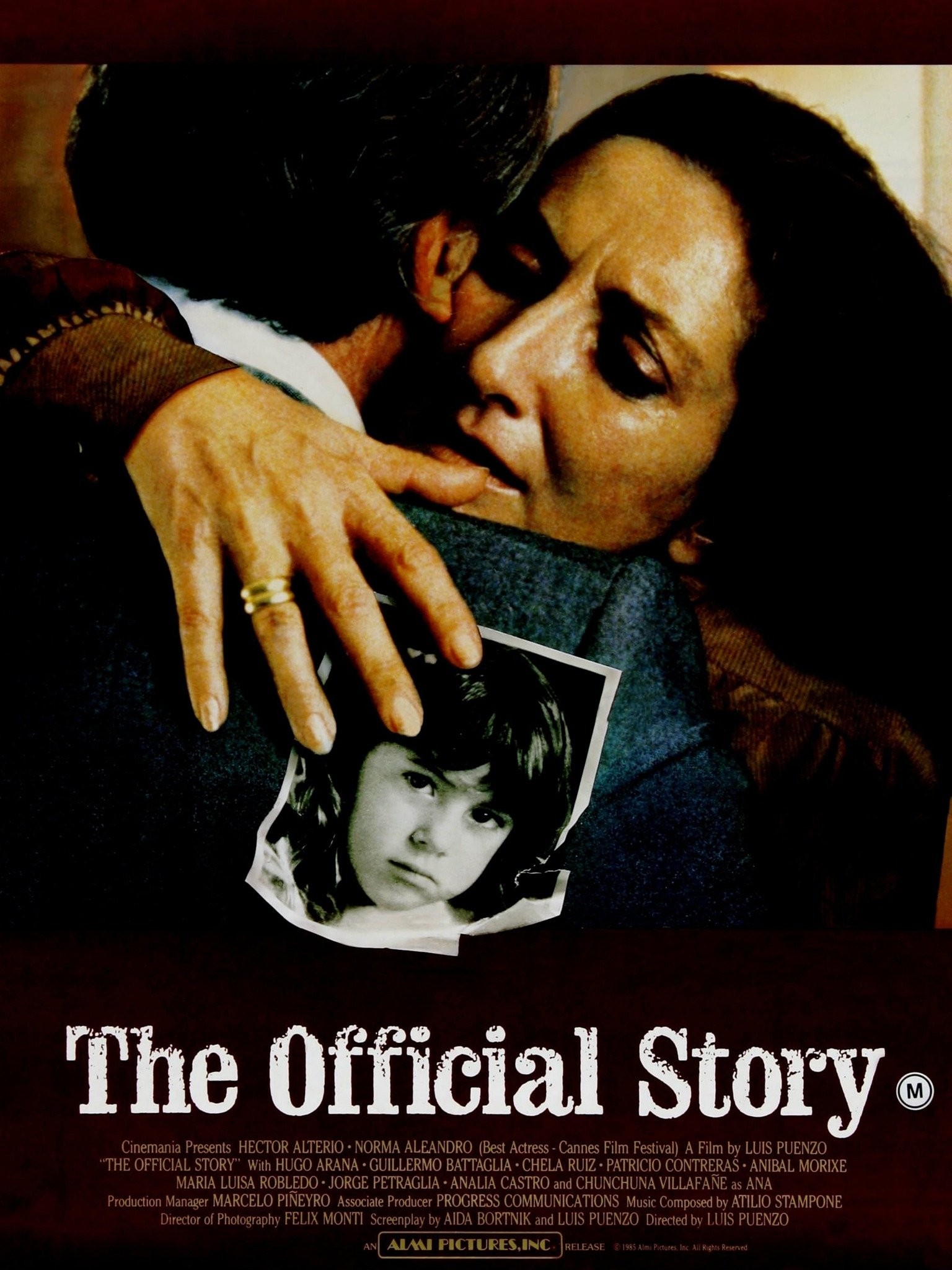
'The Official Story' La Historia Oficial Dir. Luis Puenzo (1985)
Made just two years after the return to democracy, in the post-dictatorship government's effort to be honest about the past, it submitted this film as the official Argentine selection for the Oscar. The film won, and the international acclaim that followed forced many Argentines to accept something many didn’t want to admit. Director Luis Puenzo was clever in focusing on one of the worst but most human aspects of the state violence; the abduction of pregnant women by the military who were raped before being made to give birth. The babies were then give to families often taken by military families or those with connections to the regime, their true identities hidden from the children whose mothers were murdered. In the film, Alicia (Norma Aleandro) reluctantly suspects that the daughter presented to her by her husband, Roberto (Héctor Alterio), a high-ranking military official, may have belonged to a political prisoner, so she decides to investigate – and, after many twists and turns, finds out more than she bargained for. It is one of the first, the best and has remained the most acclaimed film about the dictatorship.
'Tangos, the Exile of Gardel' El exilio de Gardel Dir. Fernando Solanas (1986)
Another of the earliest and most significant films made immediately following the return of democracy, 'Tangos' took an artistic, non-linear approach as a musical drama focusing on the memory of the exile experience, around a group of Argentinian artists and intellectuals living in Paris after fleeing the 1976 military dictatorship. They attempt to cope with homesickness, poverty, and loneliness by producing a "tango-ballet" (tanguedia) based on the music of Carlos Gardel. Featuring the emotive music of the great Astor Piazziola, it conveys the quiet pain, passion, and nostalgia of those (many still teenagers) who were forced to flee their homes and families and start their lives abroad.
'The Night of the Pencils' La Noche de los Lapices Dir. Héctor Olivera, (1986)
Based on the real-life events in La Plata on 16 September 1976, the infamous "Night of the Pencils", in which 10 high school students in were kidnapped, tortured, raped, and murdered, this film is based on testimonies, specifically from Pablo Díaz (played by Alejo García Pintos), one of the few students who survived the ordeal. It portrays their brutal detainment, with only a few survivors. For five years, the young men and women including Pablo were tortured savagely. Only Pablo's relationship with fellow prisoner Claudia (Vita Escardo) sustains him. The testimonies of Pablo were pivotal in the trials of military and police officials, leading to the imprisonment of figures like Miguel Etchecolatz for crimes against humanity.
'The Girlfriend' (La Amiga) by Jeannine Meerapfel (1988)
In the Girlfirend, the horror of the repression is seen through the enduring friendship between two women—Maria (Liv Ullmann), a suburban housewife, searching for her son, who has been "disappeared", and Raquel (Cipe Lincovsky), Maria’s childhood friend-turned-famous actress. Raquel supports Maria, but eventually is forced into exile herself in Berlin; like so many her jewish identity raises suspicions of being involved in subversive behaviour. Following the fall of the dictatorship (1983), the two friends meet again, with Raquel finding that the previously shy Maria has transformed into a resilient activist. Liv Ullmann and Cipe Lincovsky, who shared the Best Actress award at the 1988 San Sebastián Film Festival.
'A Wall of Silence' Un Muro de Silencio Dir. Lita Stantic (1993)
Starring Vanessa Redgrave sporting short blond hair, as Kate, a British director making a film in Buenos Aires about a married couple whose lives have been torn apart by the regime, this film confronts the issue of denial and silence among Argentines about their collective past. Struggling with how to guide her actors, Kate finds out that Silvia Cassini (Ofelia Medina), the woman whose life is being portrayed in the film, is now remarried, trying to forget the disappearance of her first husband. Will making a movie about it force Silvia to remember her traumatic past? Lita Stantic had been Maria Luisa Bembergs’ producer, her own husband disappeared and this was her first attempt at direction.
'Olympic Garage' (Garage Olimpo) Dir Marco Bechis (1999)
18-year-old Maria Fabiani lives with her mother Diane in Buenos Aires, giving classes to illiterate adults in the slums. Abducted by the army, Maria is submitted to torture in the underground Garage Olimpo as Diane searches desperately for her. This tale centres on the peculiar relationship that evolves between Maria and her mother’s tenant when they realize they’re on opposite sides of the political spectrum, aswell as the reationship between torturer and tortured.
'Captive' Cautiva Dir. Gaston Birabén (2005)
In 1994, Cristina Quadri (Bárbara Lombardo), a teen from a well-to-do family, leads a charmed life. But when she's summoned in front of a judge one day, she learns the shocking truth of her real parents' disappearance and her own life as a lie. Her actual name is Sofía Lombardi, and now she must live with her real grandmother (Susana Campos), a total stranger. With her life forever changed, Cristina works to uncover the deceit that for years kept her from the truth.
Sisters Hermanas Dir. Julia Solomonoff (2005)
It’s 1984 and Elena (Valeria Bertuccelli), living a comfortable suburban life in Texas, is excited to receive a visit from her sister Natalia (Ingrid Rubio), living in Spain, and who she hasn’t seen since they both left Argentina. What starts as a simple reunion turns into a tense drama as Elena begins to read their late father’s unpublished manuscript which Elena had kept and taken with her. Following the 1976 military coup, Natalia had fled to Spain after her boyfriend disappears, while Elena moved to Texas with her husband. The manuscript, however, reveals a secret that risks tearing the sisters apart.
'The Secret in Their Eyes' El Secreto de sus Ojos Dir. Juan Jose Campanella (2009)
On the surface, this multilayered Oscar-winning romance-cum-thriller revolving around gruesome unsolved murder is neither about nor set in the time of Argentina’s dictatorship. But peel off the layers, and the film's most dramatic twist could only take place in Argentina’s dirty war. For the murder culprit, which the lawyers thought was safely behind bars serving life imprisonment, suddenly appears a free man, doing dirty work for the military secret service (AAA) as it hunts down ‘subversives’ in the lead up to the coup in 1976. By connecting the 1970s with the late 1990s, the film acts as a "memory play," investigating how the trauma of unsolved crimes and disappeared individuals continues to haunt society long after the dictatorship ends.
'Eva y Lola' Dir. Sabrina Farji (2010)
Eva and Lola follows two close friends: Eva (played by Celeste Cid) works in a circus and uncovers that her best friend Lola (played by Emme) is a daughter of "disappeared" parents, stolen at birth. Eva helps Lola navigate the painful process of choosing between a comfortable lie and a difficult, true identity.
'Real Truths. The Life of Estela' (Verdades verdaderas Dir. Nicolás Gil Lavedra(2011)
The Life of Estela is a biographical drama/documentary-style film about the life of Estela de Carlotto, president of the Abuelas de Plaza de Mayo, whose search for her daughter led her to run one of the world’s most high-profile political organisations. Rather than creating a symbolic, "heroic" figure, the film shows the personal side of Estela—like Doreen Lawrence, a mother driven by profound pain and love, a housewife forced into activism by circumstances she never wished for and became a national symbol of justice.
"Clandestine CHildhood 'Infancia Clandestina' by Benjamin Avil (2012)
Set in the Dirty War, married couple, Cristina and Horacio, are guerrilla soldiers from Montoneros and are living in Cuba with their two children, Juan and Victoria. With the help of "Uncle Beto", they forge new identities and return to the country in 1979, with the aim of taking part in the leftist counteroffensive against the military junta. The movie takes the perspective of Juan, as he struggles to maintain a normal life at school given his new identity and the status of his parents as he sees glimpses of their resistance struggles.
'The Two Popes' Dir. Fernando Meirelles (2019)
Again, though not strictly about the dictatorship, this film explores the late Pope Francis’s controversial involvement in the 1976 kidnapping and torture of his fellow Jesuits, Orlando Yorio and Franz Jalics, by military authorities. While serving as the head of the Jesuit order in Argentina (1973–1979), Jorge Mario Bergoglio Bergoglio, had warned his fellow priests to stop working in slums, and when they did not, he failed to protect them, leaving them at the mercy of the disctatorship, which kidnapped and killed them.
'Argentina 1985' Dir. Santiago Mitre (2022)
The most commercial film about the Dirty War, recounting the1985 trial of the junta when the dictatorship finally ended (1983) thanks to the Failklands War, becomes a Hollywood-style courtroom drama. Public prosecutor Julio César Strassera is chosen to make the government's case against the military junta for alleged crimes against humanity after the military courts declined to press charges. The junta has the services of senior, experienced lawyers, while no senior lawyers were unwilling to risk their reputations or safety to prosecute the military. Law professor, Luis Moreno Ocampo, whose own family had ties to the military, and only had young law graduates and inexperienced lawyers at his disposal, is Strassera only choice. He has to take the risk. What resulted was the only large scale prosecution by a democratic government to date against a former dictatorial government of the same country in Latin America.