Run by an NGO called Thydêwá, the project – Arte Electrônica Indígena (Indigenous Electronic Art) – aims to encourage people to engage with indigenous cultures and challenge preconceptions. ‘Thydêwá is committed to promoting dialogue and interaction between indigenous and non-indigenous peoples,’ says Sebastián Gerlic, Thydêwá’s director. ‘The Arte Electrônica Indígena project uses art and technology to share knowledge from indigenous [peoples] with others around the world… The world needs to hear the voices of the indigenous people… At a time when Brazil [is suffering under] its worst-ever president, there is a growing need for programmes, projects and actions that raise awareness and promote change.’
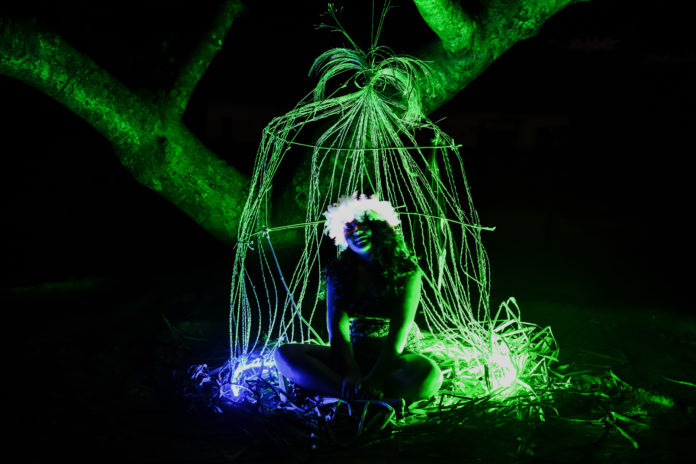
One of the artists involved in the project, originally exhibited at the Museum of Modern Art in Salvador last year, is Sandra de Berduccy, a Bolivian new media artist and weaver known as Aruma. ‘I collaborated with Mangtxai Silva [a member of the Camacan-Imboré community] on a work called “Pulsation”,’ she says. ‘It is a “cocoon” woven from both fibre optic cables and a local fibre called taboa. Visitors enter the cocoon and place their finger on a pulse sensor. As they are surrounded by lights, they visualize the beating of their hearts. For the Camacan-Imboré people, the onomatopoeic sound of the sound of the heart is “Tu-pã – Tu-pã”. Tupã is also the great spirit that contains everything. This work is like visualizing the Tupã that we all carry inside us.’
Dr Thea Pitman, a senior lecturer in Latin American studies at the University of Leeds and a curator of Arte Electrônica Indígena, believes the project has a particular resonance given the current political situation in Brazil. ‘While [the project doesn’t] directly tackle poverty or challenge invasions of indigenous territories, [it does] work well to counteract the discrimination against indigenous people by mainstream society in Brazil by offering a forum for encounters in which all participants stand to gain,’ she says. ‘I have every confidence that this is a model on which we can build in the future.’
Four pieces from Arte Electrônica Indígena, including “Pulsation”, will be on display at the British Academy’s Summer Showcase in London on 21-22 June: www.thebritishacademy.ac.uk/events/summer-showcase-2019