The Shadow of Las Malvinas
To fully understand the atmosphere in Mexico City that afternoon, one has to look back to 1982. Just four years prior to the tournament, Argentina and the United Kingdom had fought a brief but bitter war over the Falkland Islands, known in Spanish as Las Malvinas. The conflict resulted in the loss of 649 Argentine and 255 British lives, leaving deep, painful emotional wounds across Argentina.
While the players on both teams tried to treat the quarterfinal as an ordinary sporting event, the public tension was inevitable. Maradona would later admit in his autobiography that while they claimed sports and politics should not mix, the players were well aware of the context. For the Argentine team, playing this game felt less like a standard match and more like an opportunity to reclaim national pride on the only stage where they stood as equals against a global power.
The Rebel and the Genius
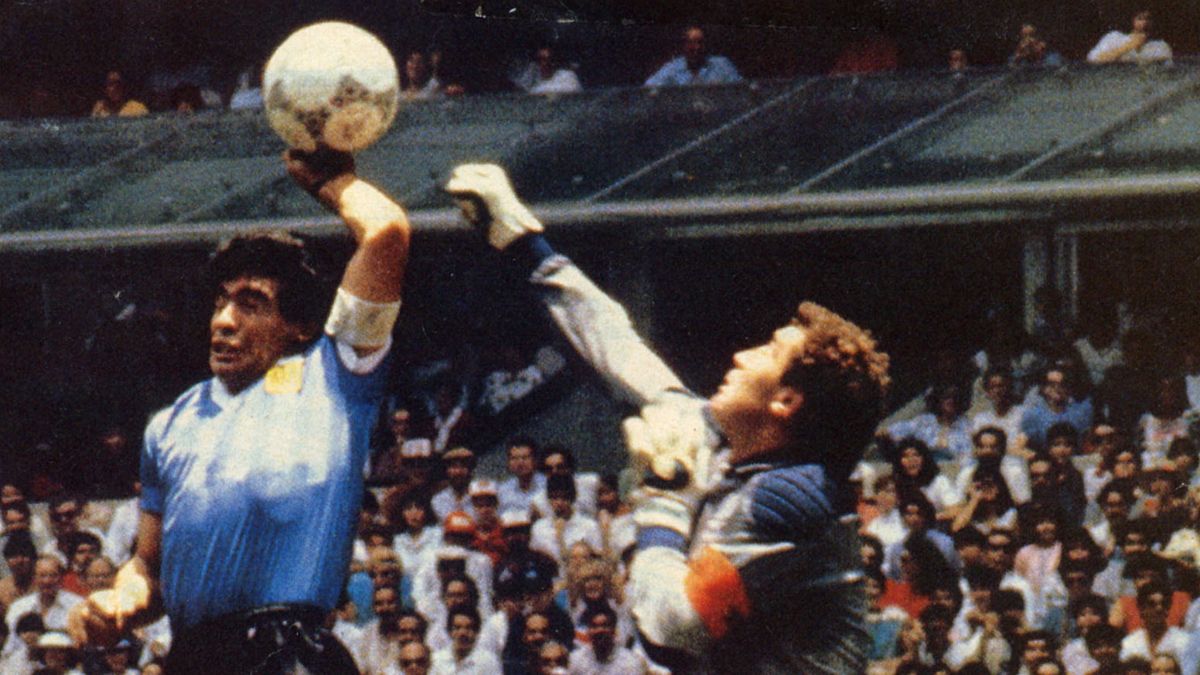
After a tense and scoreless first half, the deadlock broke in the 51st minute with one of the most famous infractions in sporting history. Maradona attempted a pass that deflected off an English defender and circled high into the penalty box. Goalkeeper Peter Shilton rushed out to punch it away, but Maradona leaped into the air alongside him. Lacking the height to win a fair header, he cleverly used his left fist to punch the ball past Shilton and into the net. The referee missed the handball, the goal stood, and Maradona later famously remarked that the goal was scored "a little with the head of Maradona and a little with the hand of God."
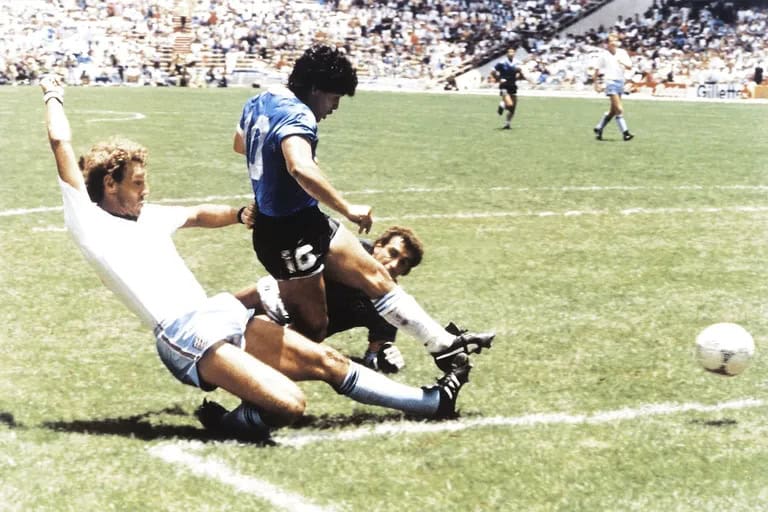
Before England could fully recover, Maradona delivered an act of pure genius in the 55th minute. Receiving the ball in his own half from a pass by Héctor Enrique, he turned away from two opponents and began a 60-yard sprint toward the English goal. He effortlessly dribbled past four English defenders—Peter Beardsley, Peter Reid, Terry Butcher, and Terry Fenwick—before faking out Shilton with a dodge and placing the ball into the empty net. It was a moment of such individual perfection that it was later officially declared the Goal of the Century.
The Road to Glory
England managed to score a goal in the 81st minute when tournament top scorer Gary Lineker converted a header, but Argentina held on for the 2-1 victory. The win sent Carlos Bilardo's team into the semifinals, clearing their path to eventually lift the World Cup trophy after beating West Germany in a thrilling final.
The Legacy Four Decades Later
Forty years later, that single match remains the definitive summary of Maradona's complicated legacy. In less than five minutes, he showed the world the two sides of his character. He was the street-smart rebel from the slums of Villa Fiorito who would use his own cleverness to overcome a superpower, and he was the breathtaking phenomenon who could do things with a football that no one else on earth could replicate.
Today, the two goals continue to live on as defining cultural touchstones. Forty years later, the match is still passed down from generation to generation as the ultimate example of football's unique power. For Argentina, the game remains a moment of collective catharsis—a day when a sport provided a sense of pride and poetic justice that extended far beyond the white lines of the pitch.
A recent documentary brought together the protagonists of that day Gary Lineker, Peter Shilton and John Barnes with their Argentine counterparts Jorge Valdano, Jorge Burruchaga, Oscar Ruggeri, who dissected the game and its context with affection and nostalgia. Of everyone, they are the most forgiving, because they were the ones who actually lived it.
From Maradona's Hand of God to Cerúndolo's Forehand of God
You could fairly say that both England and Argentina are still obsessed with the event, for different reasons. England fans love to say they were cheated, even David Beckham has referred to it as such, as if cheating is something an English person would never do. Do you remember the famous picture capturing Maradona floating mid-air with his left hand connecting with the ball? Well, it was taken by Mexican photojournalist Alejandro Ojeda Carbajal, but was falsely claimed by Bob Thomas an English sports photographer who then sold the iconic image to major stock photography databases like Getty Images for many years. How ironic.
Since that day, Maradona cemented in public Argentine consciousness an everlasting joy and pride that even his fall from grace years later couldn't undo. Yesterday, with Maradona's shirt draped over his coach's chair in the player's box at Queen’s Club, Argentine tennis player Francisco Cerúndolo became the first Latin American tennis player to win the London tournament, one of the most prestigious tennis titles in the world.
Yet, rather then giving credit to the Argentine's incredible forehand, considered by some to be the best on today's tennis circuit, the British press couldn't resist going on about 'that thing' again... "on the eve of the 40th anniversary of the Hand of God," the Guardian opened its news piece on the Argentine's victory, "Cerúndolo summoned tennis from the heavens to lift the biggest trophy of his career."
There was no divine intervention needed for Cerúndolo's victory; developing that forehand takes years of grit, practice, sweat and fight and yes, sporting intelligence. Perhaps as long as the English undervalue the qualities of others, those qualities of others will come to surprise them. For this time, it was not the Hand of God wot done it...it was the Forehand of God.