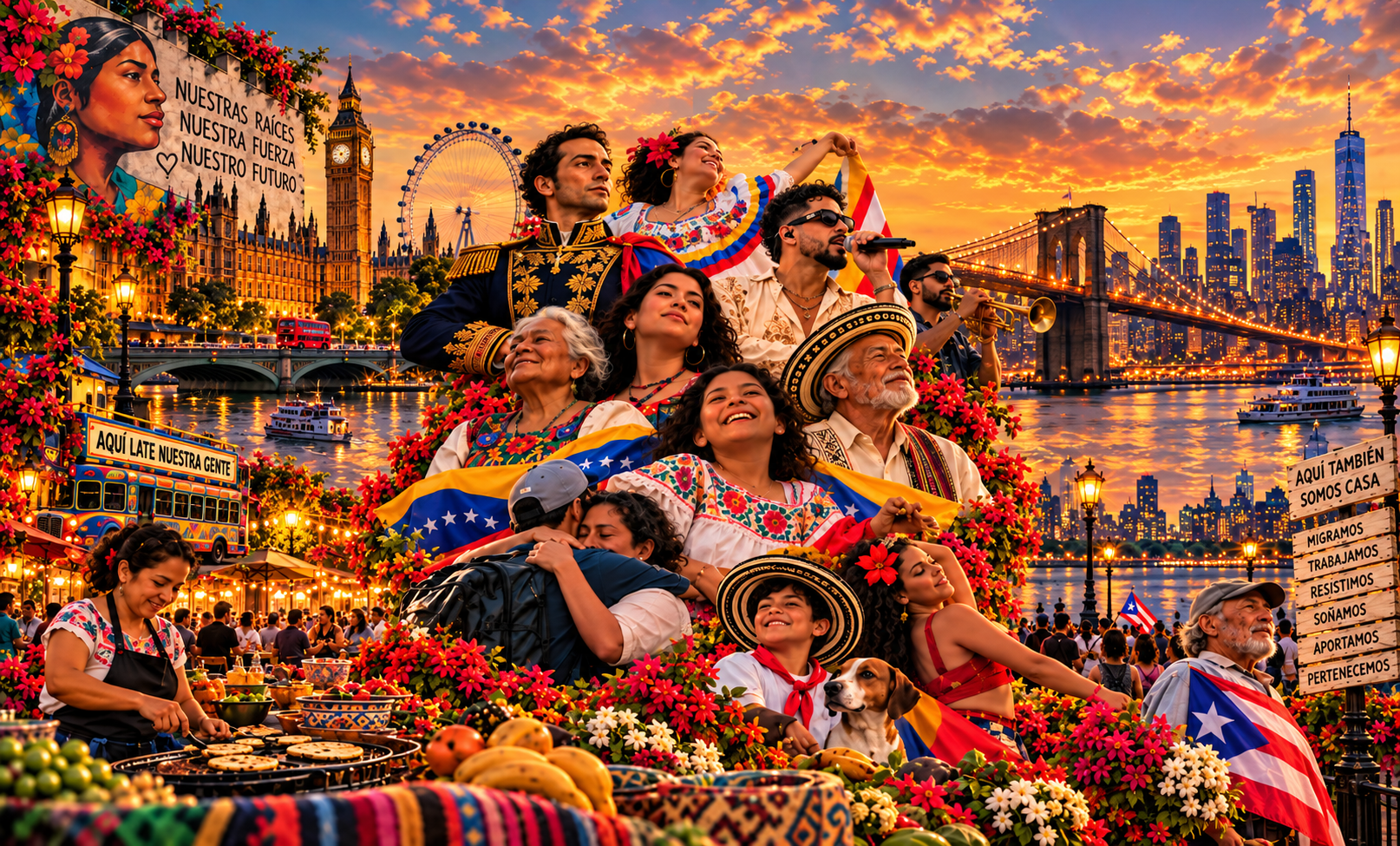
In his book "Bolívar’s Nightmare", Mexican novelist Jorge Volpi claims he discovered his Latino identity in a Latin nightclub, surrounded by Mexicans, in Spain. It is strange how something you always took for granted will suddenly swell you with pride and meaning when you are away from it. Most Latin Americans will agree, the word Latino only has any meaning at all when you are outside of Latin America.
Every year Latin American Heritage Month is celebrated in the US and Canada from September 15th, since it was instituted officially by President Lyndon Johnson in 1968 in line with the Civil Rights programme. It overlaps with Black History Month in October which, for Brazilians where the population is majority Black, is appropriate, although whether these months have meaning to the Latino and Black populations they seek to integrate is another matter.
While there are many events celebrating Latino culture, Heritage Month is not widely recognised in Europe. In the UK, Latin-Americans are not even recognised as an ethnic group on census forms and most official documents. So, what does it mean to be Latino when, as opposed to a recognised community, you are just an exotic minority from a continent, as Volpi claims, in no way unified or culturally coherent.
Do people from some Latin American countries feel more Latino than others? Is identifying as Latino a way of defending our identity? Do Spaniards and Portuguese feel Latino when outside their countries? There are way more questions than answers, but at least we have to ask them.
Historical Roots
In the 1820s, the great liberator Simon Bolívar, referenced by Volpi, attempted to forge a regional union of ex-Spanish colonies encompassing modern-day Colombia, Venezuela, Ecuador, and Panama. The term latinoamericano or Latin American, however, wasn’t used till 1856, coined by Chilean politician Francisco Bilbao and spread by French diplomat Michel Chevalier and the government of Napoleon III. The Purpose? To use the concept—which highlights Romance languages derived from Latin (Spanish, Portuguese, and French)—to distinguish the region from Anglo-Saxon America and position French resistance to the US as the dominant power in the Western hemisphere.
In 1848, after the Mexican-American War, 55% of what was then Mexico became the present-day states of California, Nevada, Utah, New Mexico and Arizona. Imagine what the geopolitical situation would be today if this had not happened? Then after the Spanish-American War in 1898, the US gained control of Puerto Rico and the Philippines – so-named by Philip II of Spain, which completed the process of pushing out the Spanish and overtaking English naval dominance.
And so, the concept of Latin-America is deeply rooted in a struggle between hegemonic powers ending with US dominance of Central and South America, expressed in the 1823 Monroe Doctrine, and recently re-ignited by Trump.
According to Nancy Gomes, a Venezuelan-Portuguese lecturer at the Universidade Autonomo de Lisboa and author of Venezuela um Pais em Suspensao, the term latinoamericano (later shortened to latino) has never been, and probably never will be, universally embraced because, while the hard power boundaries were created by men through war (hence the masculine use)k, cultural soft power does not follow the same boundaries:
“Simon Bolivar was part of an intellectual elite educated in Paris, who wanted to integrate the new states as a way to stand up to Europe and Spanish influence, but each state wanted to defend their borders and their individuality. Venezuelans, who entail many ethnic groups and races, embraced a unifying concept that we are all children of Bolivar, a Bolivarian Republic, which Chavez exploited.”
Brazilian exceptionalism is another fissure in Latin-American Identity. In a study of public opinion by the Latin America and the World project in 2016, only 16% of Brazilians said that Latin America was the most important region, while in the rest of Latin America their own region was favoured by 42%, consolidating the idea that Brazil is bigger than its continent.
Becoming Latino by Leaving
The notion that Latino identity takes place outside the home continent is a common denominator among all the Diaspora Latin Americans I interviewed, and the use of gender-inclusive Latinx, is another US-engineered idiom, hardly used in Latin America at all.
When growing up in Latin America, Jose Luis argues, the US or Europe is often the common reference. “Growing up in Venezuela, all you wanted to do was play baseball, because the US was a mythical place where things were better. In Argentina, where I go quite often there is anti-British sentiment because of Las Malvinas, yet I’ve never seen a country that loves British culture so much, a British band can sell four times more tickets in Buenos Aires than in London. When you are living in the US and Europe, however, Latin America becomes your reference because it feels like home.”
Maria Luna-Thomas a Puerto-Rican Dominican-American living in London says how you feel about your homeland “depends on time, place, politics, economics, gender, religion. Venezuelan reactions to the capture of Nicolas Maduro by the US, depends on whether you are living in Venezuela, the UK or USA, whether you are indigenous, black, white or mixed Venezuelan. Do indigenous Venezuelans feel Latino? There is no universal standard.”
Many Brazilians, like filmmaker Joao Candido Zacharias, do not see themselves as Latino until they adopt a Spanish-speaking connection: “I identify very much with Latino culture, I have family in both Brazil and Uruguay, so I say I am both Brazilian and Latino.”
And the Spaniards? In Spain itself, Gomes sees the objection of most Spaniards and Portuguese to being called Latino linked to their own sense of superiority over sudacas (their derogatory term for Latin Americans) and immigrant poverty.
But on the Latin dance floors of London, claims Venezuelan-born Jose Luis, promoter of VIVA, the UK’s most successful Latin club night, Spaniards are quite happy to identify with ‘trending’ Latin music and take the Latino label. As do contemporary Spanish artists such as Rosalía and Bad Gyal, when commercially advantageous.
Who is ‘American’ in the Americas?’
Being Latino in the US interacts with being American, but are Latinos in the US any more unified than they are in Latin America? There is no simple term like ‘Estadounidenses’ to refer to inhabitants of the US.
“It seems absurd that just one country in the Americas can use the ‘American’ when even North America includes Canada. Bu these words are changeable depending on who uses them and where,” says Joao Candido Zacharias. ‘Latino also means something different in the US than in Mexico, Brazil or Argentina.”
Meanwhile, Monica del Pilar, the Colombian editor-in-chief of The Prisma, a bilingual multicultural newspaper focusing on immigration issues, does not use the term ‘American’ to refer to people from the United States and Lélia Gonzalez, one of the major Black intellectuals of the Americas, refers to the entire continent as “Amefricano/ Amefrican.”
For most diaspora Latin Americans, geographical and social context determine feelings of Latin identity, and this applies no less to ‘Americans’. Mexican professor Eladio Bobadilla who teaches at the University of Pittsburgh notices that, ever since the “war on terror” which initially unified many in the US, American unity has been unravelling, culminating in Trump’s harking back to an imagined past, describing US Latinos in insulting language, targeting minority groups and attacking multiculturalism.
“Some conservative Latinos [in the US] who have strong assimilationist impulses, align with the American right, welcoming the attacks on multiculturalism and affirmative action. For others, it has renewed their sense of pride in their roots because they understand rising anti-immigrant and anti-Latino attitudes are existential threats and enforce a white supremacist vision of the future that erases decades of civil rights gains.”
Joao Candido points to “rich Brazilians living in Florida” as examples of those who embrace everything ‘American’. By contrast, “when Brazilians arrive in London,” Monica del Pilar points out, “many begin calling themselves ‘Latino’ to feel more included and protected by a growing diasporic community”.
The Economics of Culture
Let’s face it, even the pro-ICE bigots hatefully admit, since Bad Bunny’s Super Bowl half time Show, being latino is having a moment. “Culture is Latin America’s best export,” says Jose Luis. “It’s like our Trojan horse: people start liking music and then they are into the food and the dancing; a guy finds an Ecuadorian girlfriend and suddenly they're going to the Dominican Republic for a holiday. That's how we are conquering Europe, a kind of reverse colonialism.”
“Music is fundamental to the experience of the immigrant. It's the first thing you pass on culturally to your kids, and to others outside your community. Other people might not get into your language, but they enjoy your music,” says Jose, adding, “Bad Bunny may not be the best artist in the world, but he's opening doors for others and has made being Latino like the coolest thing in the world. Everybody, Indians, Arabs, English people, wants to be Latino now.”
Monica del pilar agrees: “Popular music and dance are fundamental channels of resistance, memory and social cohesion within Latin identity, particularly in contexts of migration and marginalisation. In Nuyorican communities, salsa became an important social expression, while Mexican-Chicano corridos and Chicano rock have expressed labour struggles and a distinct identity.”
At Sound Latino Radio based in London’s Seven Sisters Market “one guy does a show in ‘Spanglish’, and the people love them because they try to learn Spanish and English,” says the radio’s director Cesar Gamba
In the US, Eladio Bobadella points out: “Latinos express and display their ethnic pride though sports and culture; Latino supporter groups at soccer matches, Hispanic Heritage Month celebrations in baseball stadiums, Mexican flags at football stadiums.” Brands exploit this passion, but at the same time, Bobadella adds, culture spills easily into politics: “The same people protest ICE in their cities and anti-immigrant policies”.
Resisting Exploitation
Joining the diaspora is “a kind of motor that permeates my body and transforms my relations with identity, belonging and migration. It adds to my sense of dislocation as a Black Queer person who doesn’t belong in the West,” says Luiz Lucas, founding member of Legitima Defesa dedicated to Black theatre, who made the film Migranta. “This permanent sense of movement leads to a constant questioning, a search for new forms of existence. We really don't know what Africa is, because Africa for us is like the place that we have to hold onto to keep our blackness alive. It's more conceptual than real.”
Like most immigrants, many Luso-Latin Americans abroad have to be strong but are also vulnerable while we are working things out; we are pulled between people telling us what we are (or aren’t), where we belong (or don’t) and meanwhile try to cash in on our identity. For Jose Luis feeling Latino creates a “mythical construct we devise in our heads.” But this imagined identity as a migrant brings hard practical issues involving immigration documents and finding decent paid work, and migrants are frequently exploited especially when they don’t have papers, sometimes by their own compatriots.
Latinos abroad now have to navigate a new false argument agreed on by both conservatives and liberals, about having to stop “illegal” or “unauthorised” immigration, whereas in fact migration by nature is and has always been unauthorised, as Eladio Bobadilla highlights in his article for Socialist Forum “Unauthorized migration is not evidence of a broken immigration system; it is one of its defining features.”
So long as the “unauthorized migration” narrative is intentionally used by politicians and media to justify opposition to immigrants, Latinos in the UK, who are not officially recognised, will be vulnerable. This is why, one of the biggest issues for UK Latinos is to be recognized officially, Monica del Pilar, who has been key to the campaign brought by CLAUK, for the recognition of Latin American as an ethnic minority (which six London Boroughs now accept:
“Recognition brings access to a local budget for the recognized minority, interpreters and bilingual staff in hospitals and schools, health and education campaigns adapted to their needs and legal protection against exploitation and abuse at work, housing and employment policies that address discrimination against Latinos, funding and grants for Hispanic community organisations, and political influence and mandatory consultation”.
The UK situation for Latinos is not as brutal as in the US, but the lesson is clear – organization and solidarity and, to use Monica’s chosen word, ‘Resilience’, a talent ‘Made in Latin America’, are needed when it comes to being Latino, Latina, Latinx, Latine or Latin American away from home.